Francis Lyon Cohen: the passionate patriot
This article by Rabbi Raymond Apple appeared in the Journal of the Australian Jewish Historical Society in 1995, Vol. 12, Part 4, and was subsequently printed in book form.

Rabbi Francis Lyon Cohen (1862-1934) was for nearly fifty years a leading figure in the Anglo-Jewish ministry, with a career divided between England and Australia. In England his ministry at the Borough Synagogue in South London proved merely the home base for a varied and innovative range of wider involvements. In particular he was the first Jewish chaplain in British military history, and a world authority on Jewish music. With some justice he explained that his appointment to the Great Synagogue, Sydney, had aroused widespread interest “because I am myself not unknown to the public”.[1] The Great Synagogue, the oldest Jewish congregation in Australasia, occupied a position of great prestige in the life of the nation, and despite the relative smallness of the Jewish community the rabbi appointed to lead the congregation had to be a man of stature able to play a role in public life. That role Cohen enjoyed. He won acclaim as a worthy ambassador of his faith, not least because of his passionate Empire loyalties. But within the Jewish community, those same Empire loyalties embroiled him in controversy. Because of his love for Britain he was more than uneasy about political Zionism, feeling that Zionist sympathies might compromise patriotism. And because he believed strongly that Jews must integrate as much as possible into the life of the nation, he is said to have been almost the prophet of a policy of Jewish “non-distinctiveness” which may in fact have weakened the Jewish loyalties of his community.
His English period has an interest of its own for the historian. The validity of his approach to musicology, the contribution his military work made to Jewish integration into British society, the extent to which his religious views were representative of the Jewish ministry of the time – all could be studied in some depth. This study, however, concentrates more on his Australian period. This is both because it raises significant wider issues such as the place of the Jew in Australian society, the extent to which integration into a host society poses a threat to the maintenance of the distinctive culture of a minority group, and the question of multiple loyalties such as devotion to Israel combined with full loyalty to British or Australian nationality; and because of the existence in Australia of primary source material, notably letters between Cohen and successive presidents of the Great Synagogue, which this study utilises for the first time.
My own interest in the subject of Cohen’s views and career against a backdrop of Jewish and general history was aroused when, as a student in London, I became interested in Anglo-Jewish history and came across his name in widely differing contexts. It intensified when I later assumed the office in Sydney which he had held from 1905 to 1934, and found that his memory evoked two contrasting reactions – affectionate recollection, especially amongst the longer-settled members of the community, and critical comment, especially amongst those who rejected his concept of Jewish identity as entirely (or almost entirely) spiritual without ethnic content.
In 1980 when a set of old classrooms at the Great Synagogue had to be cleared prior to the commencement of rebuilding works, a number of store cupboards were found to contain many dusty parcels, wrapped in brown paper, preserving a range of Synagogue correspondence from most years of Rabbi Cohen’s ministry and later periods. From these parcels I extracted and classified the material relating to the rabbi and the issues in which he was involved, and this material has been extensively utilised in the preparation of this study. In addition, some use has been made of Cohen’s press cuttings book, covering his career until 1905 with odd material from later years. The use of this book was, however, rendered difficult because it is in relatively poor condition, and the date and source of most of the cuttings are not recorded. There are also available broken ranges of the local and London Jewish newspapers, though neither the Great Synagogue nor the Australian Jewish Historical Society possesses full sets. It is relevant to note that throughout his Sydney ministry, Cohen generally gave the manuscript of his weekly sermon to the editor of the Hebrew Standard, who gave it pride of place in the following week’s issue; Cohen’s views on religious. communal and general issues are thus well documented, and considerable use has also been made of this material.
This does not purport to be a biography of Cohen or a history of his times in Australian or even New South Wales Jewry. Its pattern is thematic rather than chronological, as it was felt that this approach would be better suited to an examination of Cohen’s thinking, his community’s response to his work and views, and the wider issues raised by a study of his career.
The obvious impression that emerges from almost every chapter is that the dominant force in Cohen’s life was his British patriotism. Whilst none of his Jewish contemporaries in Australia, or for that matter in England, would have disagreed with his basic and instinctive feeling of loyalty to and appreciation of British justice and institutions, his passionate Empire loyalty was thought by some to have been taken to illogical extremes. Thus a major puzzle was posed for many when he could apparently not bring himself to feel any enthusiasm for the fact that it was the very same British Empire which he loved so much which had promised to use its best endeavours to create in Palestine a Jewish national home, to paraphrase the wording of the Balfour Declaration of 1917. By way of contrast, Sir John Monash, whom no-one could accuse of lack of patriotism and British loyalty, asserted that Australian Jews had a double responsibility – as British citizens as well as Jews – to work for the rebuilding of the land of Israel. It is because Cohen’s patriotism was so supremely important to him that it led him even to apparent illogicalities, that this study is entitled, “Francis Lyon Cohen: the Passionate Patriot”.
In concluding this Introduction, it is a pleasant duty to acknowledge the assistance and advice of Dr Bruce Mitchell of the Department of History at the University of New England, as well as the constant helpfulness of MZ Forbes and Louise Rosenberg of the Australian Jewish Historical Society, whose immense dedication to the Great Synagogue and to the colourful history of Australian Jewry is an inspiration.
In London, the Rev. J Sunshine, archivist of the United Synagogue; Mr John Julius, acting secretary of the United Synagogue; and the staff of the Jewish Chronicle library have been most helpful. My dear friends Hyman A Simons and Phineas L May have given me much material and many leads, and I am grateful to them for this and so much else. My wife knows how much I owe to her patience and practical support in this and all my undertakings.
1. UPBRINGING AND EDUCATION
Francis Lyon Cohen was born in Aldershot, Hampshire, on 14 November 1862. His father, Woolf Henry Cohen, descended from a family that came from a village near Vilna in Lithuania. The family name of Litzky was changed to Cohen, which means “priest” in Hebrew, reflecting their priestly lineage.[2] At the time of his marriage to Harriet Phillips on 8 February 1860, Woolf Cohen (the marriage certificate omits the second name Henry though other references give both names) was aged 21 and his profession is given as that of a dealer. The marriage took place at the home of the bride’s father, Moses Phillips, in Aldershot, and was conducted by the Rev. Abraham Barnett, reader of the New Synagogue in London. The bride was 18; her father is described as a silversmith.[3] The Phillips family, originally from Warsaw, had moved from Portsmouth to Aldershot in 1855 when the military camp was established there during the Crimean War.[4]
Very few Jews lived in Aldershot at the time. There are references to one J Defries, whose firm was employed to light the schools, camps and churches in the town,[5] and to Joseph Lazareck, who held many public offices over a series of years.[6] Not until 1864 does the Jewish Chronicle record any signs of Jewish community life in Aldershot. In that year a burial ground was acquired;[7] in 1866 S Melson was president, and W (presumably Woolf) Cohen gabay (another executive office) of the congregation;[8] in 1884 Moses Phillips was president and the Rev. Isaac Jacob Cohen (it is not known whether he was related to Woolf Cohen’s family) minister and shochet (ritual slaughterer).[9] The congregation must have been very small as the standard bibliographies of Anglo-Jewish history pass it over in silence.[10] In the 1890s, however, there was a temporary Synagogue in Barrack Road, partly maintained by the United Synagogue Visitation Committee in return for facilities being made available for use by Jewish servicemen.[11] The fact that the Jewish chaplain – indeed the first Jewish chaplain in British military history – at that period was Francis Lyon Cohen has more than incidental significance.[12] It was certainly the Aldershot connection which explains his lifetime interest in military matters. Uniforms, pageantry and martial music were bound to have an emotional impact on a boy growing up near a military garrison. But he saw more than the merely superficial. We presume that the Cohen family made it their business to take an interest in the few Jewish soldiers, and thus, as Francis Lyon Cohen recalled years later, it became apparent that a Jew in the army had special problems of his own:
I had noticed, in my boyhood near Aldershot Camp, that Jewish soldiers and sailors almost invariably concealed their origin because of outside prejudices, and still more through their own people’s feeling about the difficulties in observing certain religious duties, and the dislike of all uniforms so natural in our people who had come to England from countries where authority condones such cruel oppression.[13]
In due course his own efforts as a chaplain aimed at improving the image of military service amongst the Jewish community and equally at spreading public knowledge of Jewish patriotism and loyalty.[14]
Cohen was educated at Jacob H Cohen’s private boarding school, Sussex House, Brighton. His parents may be assumed to have sent him there to gain a better Jewish education than was possible in Aldershot; the fact that they could afford the expense obviously indicates a degree of affluence. After passing the Oxford and Cambridge Local Examinations,[15] he enrolled at Jews’ College School in London. This was a day school founded in 1855 by Chief Rabbi Nathan Marcus Adler, to whom was also due the establishment of Jews’ College proper as a seminary for the training of Jewish ministers. The school lasted only 25 years and closed its doors in 1880 due to lack of support.[16] By this time Cohen had already been a student at the College itself for three years, continuing his studies there until 1885. He also attended University College and passed the Intermediate Arts examination, though he did not proceed to a degree. At Jews’ College his career was punctuated by the award of various scholarships; in 1881, for instance, the Lord Mayor’s Commemoration Scholarship and in 1885 the Lady Montefiore Scholarship endowed by Sir Moses Montefiore.[17]
One subject appeared to attract his special interest and he made it his area of unique expertise. This was Jewish liturgical music, taught by the Rev. Marcus Hast, first reader of the Great Synagogue, London, and Julius Mombach, the Synagogue choirmaster.[18] Music became Cohen’s passion. From the age of 18 he was already preparing and delivering research papers on the subject. He addressed the College Literary Society in the 1881-2 season on the Music of the Bible, and the following year on the History and Character of Synagogue Music. Other subjects on which he lectured before the Society were “The Attempts of Anton, Speidel, Haupt and Arends to Reconstitute the Psalmody of the Ancient Hebrews” (1888-89 season) and “The Hymns of Rabbi Israel Nadjara” (1891-92 season).[19] He also, at the age of eighteen, was joint honorary secretary with the veteran Rev. Aaron Levy Green of the Jewish Choral Society directed by Hast.[20]
During his student years Cohen acted as superintendent of the Chicksand Street classes of the Jewish Association for the Diffusion of Religious Knowledge, and was briefly the minister, reader, teacher and secretary of the infant South Hackney Synagogue.[21] On the retirement of the Rev. M Kaizer he became assistant reader of the Great Synagogue.[22] In this capacity he not only worked directly with and under his teacher Hast, but gained experience of the Anglo-Jewish liturgical tradition of which in later years he became the almost unrivalled custodian and representative.[23] He also came increasingly under the influence of the charms of Hast’s daughter Rose, who before long became his wife.
2. A DEVELOPING CAREER
In 1885 the honorary officers of the Hebrew congregation in Dublin came to London in search of a minister for their community. The Chief Rabbi recommended Cohen, who later remarked:
I went to Dublin at the end of May 1885, and spent a very happy year with a congregation at that time much resembling our own here in Sydney, though on a smaller scale, and combining some of the best Jewish characteristics with all the lovable charm of the finest Irish type.[24]
But, his Dublin ministry was so short that he hardly figures in the histories of the Jews in Ireland.[25] His eye was on the greater opportunities in London as well as on Rose Hast.
In early 1886 he applied for the ministerial post that had become vacant at the Borough Synagogue, Walworth, where the Rev. Simeon Singer, deemed the very model of an Anglo-Jewish minister, had held office before going to the New West End Synagogue in Bayswater. Cohen was one of three candidates. He received 51 votes at the congregational election, the Rev. HP Levy of Middlesbrough 43 and the Rev. E Collins of Belfast 7.[26] Cohen thus won the position and on 14 December 1886 was married at the Great Synagogue to Rose Hast. Dr Hermann Adler, the Delegate Chief Rabbi, conducted the ceremony and spoke symbolically of how the ancient sage, Rabbi Akiva, acknowledged that his wife’s love and generosity were largely responsible for the success of his career.[27]
From her father Rose Cohen inherited musical and vocal talents which made her partnership with her husband a cultural as well as a personal and professional one. The reputation he developed as a lecturer and writer on Jewish music was assisted by the songs and piano illustrations which she frequently contributed to his lectures. It goes without saying that her family background uniquely equipped her to support her husband in his pastoral work both in England and Australia.[28]
The Borough Synagogue was the only one south of the Thames, an area vaguely designated as “over the water”. In a sermon in Sydney, Cohen once explained that the name Borough derived from a fort or borough that used to stand at the southern foot of London Bridge.[29] Jews had lived in the district from the late eighteenth century and the congregation built up in about the middle of the nineteenth century as Jewish families moved from the City where, according to the congregational historian, warehouses were replacing the old residences.[30] The fact that a day school was established in association with the Synagogue suggests strong community feeling and adequate numbers of children, though it was never a large Jewish settlement. The congregation was scattered over an unusually wide area, estimated to have been in 1905 eighteen square miles; in 1903 there were 116 male members, 103 females and 129 children, making a total of 308 souls, one of the smallest concentrations of Jewish families in London at the time.[31]
In 1886 the Synagogue board believed there to be a “very large number of Jewish residents – mostly Germans – living in the southern suburb, who still remain unattached to any Synagogue in London”,[32] but this is probably an exaggeration. Vivian Lipman suggests that the fact that Jewish population movements mostly bypassed the Borough illustrates a “linear tendency of Jewish settlement” whereby Jewish suburbia developed along clearly defined axes which provided easy access to the City and East London, where until relatively recent times many Jews had their businesses.[33]
Among the families long associated with the Borough Synagogue were those of Baruch Cohen and his kinsmen the Levys. Rosenbaum wrote in 1917 that:
The descendants of both families have held responsible positions in the congregations of Liverpool and Sydney (New South Wales) as well as distinguished public offices in these cities, and it is a curious co-incidence that the two present Ministers of the latter congregation were taken directly from the Borough Synagogue, the selection being in the hands of members of these two families.[34]
True, the patronage of the leading families may have played a role in Cohen’s appointment to Sydney, but the support of Hermann Adler, by that time Chief Rabbi, seems to have been more significant.[35]
Some hesitation had been felt in entertaining Cohen’s candidature at the Borough on account of his being a member of the priestly tribe and thus not permitted by Jewish law to have direct contact with the dead or be close to a grave.[36] The board consulted Hermann Adler, who replied that “it would be much to be deplored if that young and promising Preacher were to be disqualified on the score of his Kehunah” (i.e. his priestly lineage).[37] Another aspect of the problem arose in the synagogue in 1890 when not only the minister but also the reader and the senior master of the congregational school were members of the priestly tribe and required to participate on festivals in the ceremony of blessing the congregation in unison; in these circumstances the junior master of the school was asked to prompt the words, a duty normally performed by the minister or reader.[38]
No such problem appears to have exercised the minds of the Sydney community when appointing Cohen in 1904. The ceremonial recital of the priestly benediction did not form part of the congregation’s ritual at that stage, and any difficulties occasioned by attendance at the cemetery were presumably left to Cohen to solve for himself. In later years he did complain of embarrassment in this respect,[39] though he admitted that “a little ingenuity can usually surmount such difficulties.”[40]
Cohen found the Borough congregation congenial. He mixed both with the social elite (when Sir Robert Waley Cohen visited Sydney in 1925, the rabbi said that in London he had “been brought into the circle in which Sir Robert’s relatives had moved”[41]) and with the less affluent members of the community who represented by far the majority of the congregation, as illustrated by the relatively low levels of membership contributions to the synagogue.[42] His pastoral interests extended far beyond the confines of South London, though he was not alone in maintaining a widespread programme of social work; most of the “establishment” ministers of the time were interested in both the East End and the West.[43] Cohen’s social work was summed up in these terms:
He has been an active participant in visitation work… The arduous and delicate duties of Visiting Chaplain to Brixton Prison are his, besides the care of Jews in quite a group of Metropolitan Asylums, Hospitals and Infirmaries. Mr Cohen has also latterly spent one day each week out of town at the Stone or Darenth Asylums or the “Exmouth” training-ship. He has served as examiner for Jewish schools and religion classes, is Chairman of the Education Committee at the South London Jewish Schools, of the South London Jewish Literary Society, the Borough Orphan Aid Society, the Newington Branch of the Country Holidays Fund (non-sectarian), and a member of numerous benevolent and educational committees.[44]
What marked him out amongst his colleagues was that he expanded the role of the minister in an unprecedented and innovative fashion by becoming an authority on Jewish music and influencing the Anglo-Jewish musical tradition,[45] inaugurating the Jewish military chaplaincy and improving the lot and the image of the Jewish serviceman,46 and as a founder and officer of the Jewish Lads’ Brigade.
The establishment of the Brigade, a Jewish version of youth movements current in other denominations, was his idea. In 1894 the Maccabeans, an association of Jewish public workers and professional men of which Cohen was a foundation member at its inception in 1892,[47] arranged a lecture by Colonel Albert EW Goldsmid on the subject of the athletic training of Jewish youth. After the lecture Cohen suggested the formation of a Lads’ Brigade and continued to advocate the idea in the letter columns of the Jewish Chronicle[48] until the movement finally caine into being in 1895. It aimed “to instil into the rising generation from their earliest years habits of orderliness, cleanliness, and honour, so that in learning to respect themselves they will do credit to their community.”[49] Cohen was Brigade Staff Chaplain and took his duties seriously, as was his wont with any activity in which he involved himself. The success of the Brigade in fostering quasi-military skills and teaching patriotism and loyalty, especially at a time of great Jewish immigration from Eastern Europe when anglicisation of the immigrant was a communal priority, resulted in as many as 80 of the 90 Brigade officers volunteering for service in the First World War and obtaining commissions.[50]
Cohen’s activities in this and other directions did not fail to bring him some criticism. Writing in 1904 to the president of the Sydney congregation he remarked:
I have always perhaps (even in my college days) varied a little from the mere conventional line of clerical activity, and have often felt impelled to go well outside of the narrower limits of official duty in directions where it seemed to me the general welfare of my brethren might be promoted. Naturally enough, any sort of individuality in a public worker exposes him to a certain amount of criticism, especially from those self-constituted authorities of whom our own community has its full share, and possibly a specially liberal allowance. But the Press, both general and communal, has proved so sympathetic to my humble suggestions on the one hand, while my own congregants have so readily acknowledged on the other that my local responsibilities have meanwhile met with adequate fulfilment, that I have been so fortunate as to reap credit for the influences I have ventured to exert during my ministrations in London, and so see some outcome to my endeavours.[51]
The Borough congregation encouraged his activities, but perhaps because of the relative smallness of South London Jewry he began to look for preferment elsewhere. When Hermann Adler became Chief Rabbi in 1891 a vacancy arose for a preacher at the prestigious Bayswater Synagogue. Cohen applied for the appointment, first informing the board of his own congregation of his intentions. They agreed to give him a testimonial in writing, which seems to illustrate the cordiality that existed between minister and congregation.[52] Cohen was not successful in his candidature – the position went to the much more experienced Rev. Hermann Gollancz[53] – and Cohen remained at the Borough.
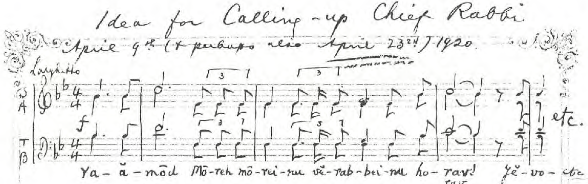
Whilst still a student Cohen’s researches on Jewish music attracted favourable attention. A youthful paper of his written in 1883 and published on the Continent as well as in England is said to have been “at once recognised as a novel and important handling of a phase of Jewish traditional culture that was still awaiting treatment by competent investigators.”[54]
His subsequent musical career took two forms – as a teacher, custodian and promoter of Jewish traditional melody, and as a scholar and lecturer concerned with the definition and derivation of Jewish music as a whole.
In respect of the first aspect, his return to London from Dublin brought with it an appointment as teacher of liturgical music at Jews’ College.[55] This enabled him to influence a whole series of aspirants for the ministry and through them to mould the musical patterns of the synagogues they served. He was called upon to take charge of the musical arrangements for many important communal occasions.[56] As early as 1887 he was invited by the readers and choirmasters of the metropolitan synagogues to work on a collection of traditional prayer melodies “as should enable every worshipper to take part in the singing”.[57] The resultant “Handbook of Synagogue Music for Congregational Singing”, jointly edited by him and BL Mosely and issued in 1889, was followed by a much larger and more comprehensive work edited by him with David M Davis and entitled “The Voice of Prayer and Praise”.[58] Colloquially known as “the blue book” on account of the colour of the binding, this became and remained for many years the standard collection of Anglo-Jewish synagogue music. Its systematisation of synagogue music may be said to have completed the series of stages, amongst which regular sermons in the vernacular must be counted,[59] whereby the synagogue attained an image of respectability and decorum in the eyes of wider society. Cohen’s scrapbook contains a sheaf of reviews, mostly laudatory though not uncritical, of the blue book; some reviewers, however, impliedly accused him of arrogance in purporting to be the authoritative arbiter on the subject.[60] Another task Cohen undertook as a recorder and redactor of traditional music was that of popularising old melodies by associating them with paraphrased English texts. A selection of these melodies appeared in “Lyra Anglo-Judaica”, issued in 1891. Material on specific melodies and their background and significance was also presented in his frequent articles in the Jewish papers. One example, which appeared in the Jewish Chronicle the week before his appointment to Sydney was announced, was on a Passover melody, the music being printed in full with the heading, “In a Strange Land: traditional melody, adapted to Lord Byron’s verses by Isaac Nathan, 1815, arranged, from earlier transcriptions, by the Rev. FL Cohen.”[61]
The wider field of the nature and history of Jewish music engaged his attention for many years. He lectured extensively, often with Mrs Cohen providing the musical illustrations, before many Jewish and general audiences in England, on the Continent and in the United States. Most of his lectures were published in Jewish or learned periodicals, and some as separate monographs. Some of his articles permitted themselves a somewhat polemical tone, and some appeared under the pen-name of Asaph Klesmer; Asaph was a Biblical musician and Klesmer is a popular corruption of k’le zemer (musical instruments).
One author suggests that Cohen’s theories are “in the same half-scientific, half-artistic vein as is Renan’s famous proof of the non-existence of Moses or his repudiation of the Exodus” and accuses him of “purely psychological casuistics, drowning in a torrent of dramatic verbiage … in contradiction to every bit of historical evidence.”[62] Other assessments are more generous as well as less intemperate in language. The vast amount of work he put into editing (and largely writing) the articles on music in the Jewish Encyclopaedia led a Sydney paper to call it “an acknowledged fact throughout the world” that he was an expert on the subject; it added, “if the work he has completed for the Jewish Encyclopaedia were to be collated from the twelve volumes, it would require a number of books to itself.”[63] The Jewish Chronicle considered his Encyclopaedia article on cantillation to be “of distinct scientific value, and remarkable for an unprecedented presentment of the parallel forms of the Neginoth” (notes for cantillation).[64] A popular essay on the subject refers to his “masterly article on synagogal music in the Jewish Encyclopaedia,”[65] whilst another deems his work to be an “authoritative statement”.[66] Years after the Encyclopaedia had appeared, Cohen derived pleasure from favourable reference to his contribution.[67] Coming at a time when much of his communal activity in Australia was attracting criticism and even denigration,[68] one can understand his pleasure at being appreciated. The field of Jewish musicology has developed considerably since his time and his name hardly figures in modern works on the subject, but his contribution to the laying of foundations for modern Jewish musical research has historical significance.
After he arrived in Sydney his many other responsibilities left him less time than before to pursue his musical interests, and though he took a keen interest in the Synagogue choir and gave occasional musical lectures, his major work as a musicologist was over.
From boyhood days Cohen had been interested in military matters. The well being of the few Jews stationed in Aldershot must have been a matter of renewed concern to him every time he visited the town. The community in London had so far taken no official interest in the subject, but early in 1892 he urged the Visitation Committee of the United Synagogue to organise ministerial visits to Aldershot.[69] His suggestions were taken up and the Visitation Committee recommended that the War Office appoint him as “the first Jewish Minister recognised in connection with the British army.”[70] With the assistance of the small Aldershot community he began seeking out and befriending Jewish members of the garrison, at first paying a weekly Sunday morning visit to conduct services for them and later involving senior students of Jews’ College in the work.[71]
His motives went beyond the merely humanitarian. He was determined to make soldiering respectable amongst Jews, especially because this was a time when vast numbers of Eastern European Jews were arriving in England bringing with them a justifiable set of prejudices against the hated authority which uniforms represented for them, as well as the feeling, reinforced by the experience of Jews conscripted into the Czar’s armies, that military service entailed religious compromise.[72]
In addition, he was disturbed by allegations that Jews were unpatriotic. Evidence that there were Jewish members of the armed forces would have helped to counter these accusations. But no-one knew how many Jewish servicemen there were. It was not only that the Jewish community itself had not taken an interest in the subject. In many cases Jews hid their religious origins – some out of lack of religious commitment, but many because until 1886 the army simply did not officially recognise Judaism as a denomination that could be recorded for attestation. Though Jews had had naval and military connections in England from the time of Cromwell or even before,[73] it was not until Major-General Sir Frederick John Goldsmid, a Crimean War veteran, made determined representations that Judaism received formal recognition for military purposes. Cohen acknowledged Goldsmid’s efforts but insisted that credit also be given to private soldiers like W Cohen of Mare Street, Hackney, who while serving in the 5th Lancers regularly insisted on reporting himself as a Jew.[74] Historians who believe that 1858, with its parliamentary emancipation of Jews in England, represented the culmination of efforts for Anglo-Jewish emancipation, have failed to recognise fully the significance of 1886 in the emancipation process.
When Cohen began work as a chaplain, the available military congregation consisted of one man, a former pupil of the South London Jewish Schools.[75] By 1895 he could report,
About thirty-two Jewish regulars and militiamen at Aldershot, and twenty-eight at other stations, have come under my notice during two years of officiation, quite fifty of whom are at present serving in the army … Some ten or eleven Jewish recruits joined the troops at Aldershot during 1894 … It would appear that between sixty and seventy Jews enlisted during the year … I estimate that there are now quite two hundred Jews in the Army, and that by the end of the century the number will reach and perhaps exceed four hundred.[76]
He provided regular military statistics to the Jewish Year Book, first issued in 1896, considering the increasing numbers as good for Jewry and good for England. In 1904 he estimated that one in 188 English Jews was a soldier, compared to one person in 148 in the general population. Though he insisted he was not a recruiting sergeant, the new image he gave the Jewish soldier must have aided enlistments.
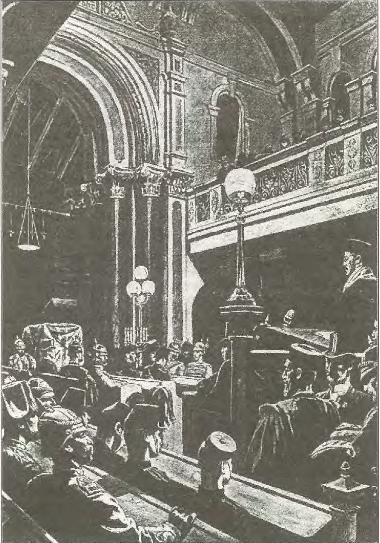
He hit upon a dramatic method of attracting both Jewish and gentile attention by inaugurating an annual Jewish military service held in one or other London synagogue on the festival of Chanukah, which commemorates the exploits of the ancient Maccabee warriors. The first such service took place at the Borough Synagogue on 10 December 1893. One of the most notable military services took place during the Boer War, at the Central Synagogue:
With all the solemnity and impressiveness of Jewish liturgy, the ninth annual special military Hanuca service was held yesterday at the Central Synagogue, Great Portland-street. The Lord Mayor was present in state, accompanied by the Lady Mayoress and Mr Alderman Sheriff Bell and Mrs Bell. They were accommodated with seats on the left of the Ark, the Chief Rabbi being seated immediately opposite the civic party. The pulpit was gracefully draped with Union Jacks, and the space between it and the almemor or platform where the service is conducted was occupied by soldiers of the Jewish faith in uniform …
An appropriate sermon was preached by the Rev. FL Cohen. After pointing out that Jews were to be found serving in the Navy, Militia, Regulars, Yeomanry, Volunteers and Colonial irregular corps, he went on to say that the present war had, and was, exacting its full tribute of blood and tears from Jew and Gentile alike. Nearly 100 Jewish soldiers slept on the field of honour side by side with the many thousands of their comrades of other faiths, for all of whom their hearts were bleeding and their eyes welling full.[77]
The military services aroused some criticism within the Jewish community but were supported by Lord Rothschild, lay head of the community, and by 1905 they were widely acclaimed as “an annual feature of Jewish communal life in London.”[78] After Cohen left for Australia the new chaplain, the Rev. Michael Adler, continued the services, and Cohen himself attempted to imitate them in Sydney, but they lapsed at about the commencement of the First World War.[79]
5. APPOINTMENT TO SYDNEY
In 1903, the Rev. Alexander Barnard Davis retired as chief minister of the Great Synagogue, Sydney, after 41 years’ service. His board of management began the search for a successor. His assistant since 1892, the Rev. JH Landau, declined to contest the appointment on a competitive basis, and went to the United States. The board asked its past president, George Judah Cohen, who was on a visit to London, to consult the Chief Rabbi. The latter, together with Neville D Cohen and Benn W Levy as representatives of the congregation, recommended that Francis Lyon Cohen be appointed. The Chief Rabbi’s long record of support and encouragement of Cohen led him to believe Cohen to be a reliable public representative of Judaism with the English background and proven patriotism that would be right for a leading colonial congregation.
The Great Synagogue accepted the recommendation with the proviso that Cohen qualify within twelve months to assume the presidency of a local Beth Din or rabbinical court. This proviso was deemed of the utmost importance by the leaders of the Sydney community. Despite its pre-eminent position as the mother congregation of Australian Jewry, with origins going back to convict days, the Great Synagogue had never had a fully qualified rabbi competent to conduct a Beth Din. Davis was popularly known as “Rabbi Davis” but he had no rabbinical diploma, and the Beth Din which Nathan Marcus Adler had reluctantly allowed him to form had severely circumscribed powers. This contrasted with Melbourne, where there was a permanent Beth Din headed by Rabbi Dr Joseph Abrahams. In Sydney the lack of a rabbi and Beth Din encouraged the emergence of so-called “religious charlatans” whose pretensions it was hard to control,[80] and of “foreign” rabbis who denigrated Davis and his authority.[81] Thus a combination of self-respect, communal discipline and simple efficiency made it essential for the new chief minister to qualify as a rabbi before assuming office.
Cohen accepted the appointment subject to this condition. He announced his resignation from the Borough Synagogue when he addressed his congregation on the first day of Passover and evoked an emotional reaction, especially from the ladies.[82] After relinquishing his congregational duties he embarked upon what he called “the literary, physiological and juridical studies required in addition to my present theological and homiletical qualifications.”[83]
His plans became, however, the subject of controversy. His letters to Sydney speak of “conspirators” who sought to place obstacles in his way. Was it that there were doubts as to his orthodoxy? The fact that in 1892 the Borough Synagogue asked the Chief Rabbi to approve 35 changes in the ritual, some quite radical, does not reflect adversely on Cohen.[84] The Chief Rabbi had convened a conference of ministers to consider synagogue ritual in detail; the Borough Synagogue’s proposals were neither stated to be approved by the minister nor presented officially on behalf of the board but simply summarised suggestions that had been put forward from time to time.[85] There is surely also some significance in the fact that though one of the 35 suggestions asked for approval of a mixed choir of men and women, it was not until 1899 that the Synagogue introduced such a choir, long after the Hampstead Synagogue had led the way despite Hermann Adler’s disapproval.[86] Cohen’s orthodoxy was representative of the religious position of most of the “establishment” ministers of the period, even though his views became more lenient as his Sydney career progressed.[87]
He did have his critics who thought him too much of an individualist who had often gone “well outside of the narrower limits of official duty”.[88]
But the “conspirators” appear to have wished to embarrass the Chief Rabbi more than to discomfit Cohen. For many years the Chief Rabbinate had not wished to encourage ministers to become fully qualified as rabbis:
The constitution of the Jewish ministry in England presented an anomaly which was not to be found in any other country. The head of the Jewish ministry was styled the Chief Rabbi. But it was not considered necessary for any of the ministers under his jurisdiction to possess rabbinical status, so that his own position very much resembled that of a general without an army.[89]
The powerful voice of Hermann Gollancz, who had gone abroad to gain rabbinic ordination, led those raised in insistence that there be a proper course of rabbinic study available in England. Gollancz wrote that his agitation caused “a storm in the hierarchical Chair”.[90] Adler agreed in the end, but by approving Cohen’s appointment as president of a Beth Din before gaining the rabbinical diploma aroused the indignation of Hermann Gollancz’s brother Israel, an eminent academic, who wrote an open letter to the Chief Rabbi which was published in the Jewish Chronicle.[91] Israel Gollancz spoke of “widespread discontent” in the community at the news of what the Chief Rabbi had approved; to say that Cohen’s examination for the rabbinical diploma would take place a year or so after his appointment had been confirmed was to “run counter to every method of fair procedure” and would produce nothing but a “make-believe degree”.[92] In the course of subsequent press correspondence BW Levy stressed that the Chief Rabbi had made it clear to Cohen that the appointment was conditional on the rabbinical diploma examination being satisfactorily completed,[93] but Israel Gollancz returned to the fray several times.[94] Cohen wrote to Sydney that he believed “Mr Gollancz is not acting solely on his own initiative, but rather as the mouthpiece of a faction whose consistent aim is the mere thwarting of Dr Adler”.[95] He suspected that the Chief Rabbi would have to make the examination so difficult that the critics would be disarmed.[96]
Cohen spent almost a year in intensive study and also gained practical experience at the London Beth Din. His examination took place at the end of March 1905. On the day the examiners asked that he accept no proselyte, and administer no religious divorce, without reference to them. He replied that he could not agree to anything which would fetter the autonomy of the Sydney community. They then asked that he obtain the assistance of “a gentleman who holds the diploma from a competent authority” (the rabbi they had in mind may have been Dr Abrahams of Melbourne who had qualified on the Continent) before preparing divorce documents to be sent abroad, and to this Cohen assented. The results of the examination were favourable; Adler wrote to BW Levy to confirm that Cohen had passed “creditably”.[97]
After farewell functions which included a dinner given by the Maccabeans, and a Jews’ College reception presided over by Jacob Danglow who was soon to follow Cohen to Australia, Rabbi and Mrs Cohen, with their two sons and daughter, sailed on the SS Salamis on 2 May. They reached Sydney on 17 June and Cohen was formally inducted into office at the Great Synagogue by his much revered predecessor on 25 June.

Cohen attached great importance to his role as a preacher. Sydney had in fact enjoyed a tradition of regular preaching long before English sermons had become an established feature of synagogues in England. The first recorded Jewish sermon in England dates from 1817, though occasional sermons had been given before this date.[98] Ministers were chosen not for their learning or homiletical ability but for their vocal talents. Their major role was as officiants or readers (the latter term is one of a number of marks of Jewish acculturation to the ways of the established church[99]). The Jewish press increasingly advocated the introduction of regular sermons or lectures, both in order to raise the low levels of religious knowledge of the masses of the community and as a weapon in the struggle for emancipation. This was a time when preaching was highly esteemed amongst the general community, and sermons were seen as instruments of “seriousness of thought and self-discipline of character”.[100] The image of the Jewish community was considered to be in jeopardy if the synagogue had neither preaching nor preachers. The Jewish Chronicle declared in 1849,
We are anxious to obtain full emancipation; and would it not be a disgrace if we were told by our Christian opponents, that the Jews of England are so ignorant that they cannot find a lecturer in their community?[101]
In Sydney the community had been well served in this respect from the time of the Rev. Herman Hoelzel in the mid-1850s. AB Davis, minister from 1862, preached regularly and eloquently, walking up and down the steps leading to the Ark; the synagogue had no fixed pulpit until 1899.[102] In his old age Davis was assisted by the Rev. JH Landau, who had considerable oratorical powers. Both David and Landau had a flowery style and used abundant reference to Biblical quotations.
Cohen’s style and subject matter are relatively easy to examine as he generally used carefully prepared manuscripts. Left on the pulpit each week for collection by the editor of the community newspaper, the Hebrew Standard, they were published on the front page of the following week’s paper. Twenty-nine years of almost weekly sermon-essays of this kind, carefully preserved in the files of the Standard, represent a solid, sustained contribution to Jewish homiletical literature in English. Significantly, a rival paper, the Australian Jewish Chronicle, from its inauguration in 1922 hardly ever even reported Cohen’s sermons though it published those of other ministers, including the Rev. LA Falk whose passionate Zionist views accorded with the paper’s own position.
Cohen’s style in his earlier years in Sydney was ponderous and academic. He often went over people’s heads, and this might explain his complaint in 1928 that:
The sudden departure of congregants, not all children, as soon as any Sermon commences has disconcerted visiting Preachers, and involves delay sometimes in my own commencement. Can some more extended policing check this?[103]
It is also possible that his unpopularity with those congregants who were offended with his views on Zionism might be connected with the sermon-time walk-out.[104]
Despite the consistent intellectual content of his sermons he did not lack the ability to speak in very direct terms which left his audience in no doubt as to his meaning. The following are two examples:
It is a peculiar form of Judaism which spends guineas on fiddling and waltzing, and grudges shillings or even pence for Hebrew … What the Jews of Sydney lay out on theatres and variety shows on one single Saturday night, or at the card table one Sunday night, would suffice to keep our Education Board financial for a whole year.[105]
A daughter of Israel who knowingly purchases for her household meat which has not been regularly slaughtered by an approved Shochet and is therefore “nebelah”, is in fact deliberately withdrawing that household from the ranks of am kadosh, “God’s holy people”.[106]
His sermons generally took some twenty minutes or so. The fact that this was so much less than the length of many Christian sermons did not reassure his board of management. In 1922 his president wrote to him about “the vexed question of the time required for your Sermons” and asked him to comply with the board’s request that he should not exceed fifteen minutes. “This is a very sore question with the Board, I am afraid,” the letter went on, “and we would be glad to see it finally disposed of without friction.”[107]
Cohen’s reply expresses his hurt at having “hurled” at him a request “which my own forty years’ experience, and the opinion of experts in all communions, finds impracticable,” and adds, “Nor do I consider I should be so constantly worried over a trifling difference of five minutes at most, in the very nature of the circumstances often inevitable.”[108] (This exchange of letters appears to underline uncertainty on both sides as to the proper relationship between rabbi and board. To what extent was the rabbi a servant of his board and bound to adhere to its instructions? This question will be considered at greater length in a later chapter.[109])
The subjects of his sermons ranged from matters of Jewish law, belief and practice to wider questions of community and national policy. On national issues he sometimes advocated a clear and specific point of view. Thus, disappointed that Jews who observed the Saturday Sabbath were not always accorded the right to work on Sundays, he deplored the fact that Australia was
A country which penalises the observant Jew in business by refusing to recognise his conscientious scruples with any generous liberality like that displayed by the Old Country in her Factory Acts.[110]
Usually he refrained from taking sides in matters of national controversy and addressed himself to the underlying ethical principles that both sides ought to respect. Hence a reference in 1909 to an industrial dispute (the reference seems to be to Broken Hill) which he said had been “greatly augmented by reprehensible explosions of a foolish violence,” adding, “We anxiously pray that hot-headed impetuosity may not be misled into shedding the blood of warfare in time of peace.”[111] His care not to take sides was derived to a large extent from the concern he shared with most of his congregation that the Jewish community not be seen as politically partisan. No Jewish action or utterance should be embarked upon, he believed, if it might, even unwittingly, jeopardise the Jewish position in Australia. This policy led him on several occasions to warn Jews to be ethically scrupulous and not put the good name of their community at risk:
Any liar or deceiver who happens to be of Jewish origin, by these very transgressions marks himself off as one who deliberately separates himself from the Religion of the Jewish people.[112]
He did not however hold back from speaking out on current theological issues when he felt Jews might be confused as to where Judaism stood, or even when Christians might need to be informed as to the way in which Judaism understood passages of Scripture which Christianity handled differently. Jews sometimes objected to his use of the synagogue pulpit to discuss such matters. The question of the virgin birth of Jesus, some argued, had no place in a Jewish pulpit.[113] Others said that his public references to differences between Christians and Jews would arouse ill-feeling towards the Jewish community.[114] On these matters, though, most Jews who took the trouble to express themselves supported his stance, and this included even the Australian Jewish Chronicle which on Zionist questions disagreed with him.[115] He trod boldly into the arena when attempts were made to establish missionary organisations aimed at converting Jews to Christianity. Calling such groups “misguided interlopers into our private affairs,” he warned them: “Leave us alone; leave your fellow-citizens of the Jewish persuasion to the lofty religious belief they already hold, and which they have not less right to hold than you have to hold your particular creed.”[116] His use of the word “right” in this context carries with it more than a hint of the nineteenth-century struggles over the legitimacy or otherwise of non-Christian groups on Australian soil.[117]
On internal Jewish issues he insisted to his congregation that modern Judaism did not necessarily believe in customs and superstitions from “the backward parts of Eastern Europe,”[118] a somewhat unfortunate phrase which reinforced the hostility towards him of some of the more recent immigrants from Eastern European countries.[119] He argued that neither extreme orthodoxy nor radical reform were right for Australia, but his advocacy of liturgical modification led some to think of him as “an insanely reform rabbi”.[120] Someone once, Sheridan-like, suggested that it might be said of him, “Rabbi Cohen is a traditional exponent of Jewish music and is himself a composer of Jewish law!”[l21] His religious views and attitude to Zionism, both of which invested many of his sermons with a controversial quality, are dealt with in detail in later chapters.[122]
He showed a completely different side to his capacity as a preacher when he occasionally gave Talmudic discourses to devotees of traditional learning. As early as 1906 he spoke on the second day of the New Year festival at the Masonic Hall services of the Baron de Hirsch and Hebrew Benevolent Societies, groups which generally preferred to pray in a less structured and anglicised atmosphere than that of the Great Synagogue. His address “took the form of a drosho,[123] by an old-fashioned Maggid,[124] and the novel interpretation of the text and frequent Talmudical references were much appreciated.”[125] In 1925 a group of learned men established the Chevra Midrash, a Sabbath afternoon study group at the Maccabean Hall in Darlinghurst, and his lectures to the Chevra likewise followed an old-fashioned pattern.
He often addressed audiences, both Jewish and general, on Biblical and other Jewish subjects. As a freemason he was much in demand for his lectures elucidating points of masonic ritual and teaching in the light of Jewish history and literature. He was considered unrivalled as an after-dinner speaker. His lectures, even to Zionist groups with whose major policies he was out of sympathy, evoked commendations in terms such as “considerable erudition … great usefulness … humorous … delighted all present … most interesting and scholarly … blended considerable humour with the serious interest of the subject.”[126] He attracted much praise for a two-hour impromptu lecture on Jewish history at the Maccabean Hall, when a function, cancelled because it was deemed religiously inappropriate, had to be replaced at short notice.[127]
Parallel to his capacity as a preacher was his ability as a teacher and inspirer of children. For all that some accused him of holding himself aloof from members of the community and even posting a dog at his front gate to discourage callers, many members of the community, now elderly, speak fondly of his warm interest in them when they were children, and recall that he welcomed them to his home.
He believed that religious instruction was “the first duty and highest privilege of a minister of religion in all communions,”[128] and he threw himself with great enthusiasm into the community’s educational work. There was no Jewish day school at the time, but a tripartite system provided Sabbath classes, Hebrew and religion lessons on Sunday mornings and after school hours during the week, and withdrawal classes at state schools. As both president and director of education he worked energetically, teaching, supervising, establishing curricula, visiting classes, raising funds, and seeking greater parental involvement. MH Kellerman says:
Rabbi Cohen, a keen educationalist, energetically furthered the cause of Jewish Education in Sydney. He reorganised the centres, updated and enriched the Syllabus, and implemented the improvements suggested by the Chief Rabbi. He was responsible for the constitution of the two Boards of the time into the NSW Board of Jewish Education in 1909; developed the Sabbath School, Right of Entry classes, and participation of pupils in Synagogue services, and strengthened co-operation between the Board and the Great Synagogue. He regularised the tests for prizes, barmitzvah and confirmation, and became the first Director of Education in 1928, when Mr Saul Symonds became President. He faced great difficulties during World War I, and the early stages of the Great Depression; also problems associated with the introduction and spread of Secondary education, and the dispersion of the Jewish population in suburban areas.[129]
The reference to suburban areas denotes more than the obvious fact that centres had to be opened in new districts. It also reflects the suburban suspicion of both the Great Synagogue and its rabbi.
For many years the Great was the only permanent synagogue in Sydney and it was not until 1913 that synagogal accommodation for suburban residents began to come into being. Both Cohen and his successive presidents encouraged and assisted new congregations to come into being, but there was a feeling that the Great wanted to control the whole community.[130] This expressed itself in the early 1920s in particular, when the Eastern Suburbs Central Synagogue opposed the creation of a United Synagogue federating all the New South Wales congregations,[131] and when independent education boards were set up both by the Eastern Suburbs congregation and by supporters of the Rev. AT Chodowski (whom Cohen disliked and called “that creature”[132]) in Randwick-Coogee. Chodowski’s paper, the Australian Jewish Chronicle, criticised the Education Board which Cohen headed, saying that less than half of the eligible Jewish children were receiving any form of religious education.[133]
Cohen’s view was that the problem lay less with the Education Board than with the parents. From the moment he arrived in Sydney he had been proclaiming that “many young Israelites in Sydney receive no sort of systematic religious training whatever”.[134] Even communal self-respect ought to motivate parents towards ensuring their children received Hebrew education, he said; the numbers attending the Sydney Jewish Sabbath School were “only one seventh of the number they might expect if Jews in Sydney were as earnest in the religious education of their children as certain of the non-conformist Protestant sects.”[135] His efforts at securing parental co-operation never met the kind of response he hoped for. In 1924, at the time when he was being attacked by the suburban boards, he declared:
There is nothing dearer to my own heart, nothing in which I am more deeply concerned, nothing on which I have pleaded more often and to many since I first came amongst you – and there is nothing in which I have encountered more disappointment.136
The criticism of his efforts was not total. The Australian Jewish Chronicle might attack him, though it acknowledged how successfully he kindled enthusiasm amongst the children for functions such as a Chanukah function at the Maccabean Hall in 1923, a few weeks after the opening of the Hall in November that year, and called the children’s celebration “the most impressive … ever seen in Sydney.”[137]
7. MINISTER AND ADMINISTRATOR
Cohen was a diligent pastoral minister and a good administrator; his president said he was “the equal in ability and capacity for work within and without the congregation of any whom we may hope to acquire,”[138] and the Hebrew Standard declared that “Rabbi Cohen’s administrative ability has been shown to be successful.”[139] He carefully prepared rosters allocating ministerial tasks amongst all the clergy of the congregation who, besides himself, were the Revs. Abraham David Wolinski and Philip Philippstein, veterans who had served the synagogue since the early 1880s; the Rev. Marcus Einfeld, appointed in 1909; and the Rev. Leib Aisack Falk, appointed in 1922. He often complained, however, that they did not give him adequate support and respect. One minister he called an “old man of the sea”.[140] Another described as “a subordinate who looks at everything from a different angle”.[141] With the arrival of a third, who asserted he had “come out to uphold orthodoxy,” Cohen felt himself to be “sitting on the edge of a volcano”.[142] As head of the Beth Din, Cohen co-opted them as “assessors” to assist him in handling ecclesiastical cases, but complained that they did not always keep Beth Din proceedings confidential.[143]
A major problem was that the Great was the only permanent synagogue in Sydney until 1913, and it was the only congregation with official incumbent clergy. It, therefore, had to provide ministerial services for thousands of Jews throughout the city and state, whether they were members of the synagogue or not. In 1911, when there were 7660 Jews in New South Wales,[144] less than half of the Jews of Sydney attended services (at the Great or the overflow services at Newtown, the Baron de Hirsch Rooms and the Hebrew Relief Society) on the Day of Atonement.[145] The need for additional synagogues and more clergy was clear. When suburban congregations came into being, their lay leaders and ministers came to Cohen and the leadership of the Great for assistance and advice, but felt that the Great was trying to dominate them. Thus, moves to establish a United Synagogue of New South Wales in the 1920s failed because of resentment at the size and strength of the Great and a feeling that it was “dominated by people of social position,” making relations with other congregations into a “distinct class war”.[146]
Cohen for his part feared that the ministers appointed by other synagogues generally lacked training and even tact, and urged that they accept his guidance to ensure that they did nothing which would affect the good name of the Jewish community or contravene Jewish law. Deploring a tendency to appoint “other than British-trained men”, he pointed out what he called
… the calamitous effect, on the Jewish reputation and status, of any and every action or utterance of persons in such a responsible position, which may run counter to the legitimate feelings, the conventions, or even only the prejudices, of the majority amongst whom our lives here have to be lived.[147]
Whilst all the ministers made public protestations of patriotism,[148] the “other than British-trained men” and the generally more traditionalist groups they served, felt that Cohen and the Great were too anglicised and that they were more concerned with raising the status of the Jews in gentile eyes than with increasing Jewish commitment.[149] The Great Synagogue itself did not lack its own traditionalist lobby, not necessarily composed of recent immigrants. Cohen was on bad terms with a number of this group; one of its vocal members he called “his lordship … amateur rabbi … swelled head.”[150] Cohen resented the attempts of such people to put pressure on him, and at one annual general meeting the president commented, “There has been too much dictation on the part of well-meaning laymen to lay down the Jewish law to their spiritual leaders.”[151] This did not solve the problem, and in welcoming the appointment of Sydney’s second rabbi, Rabbi Gedaliah Kirsner, to the Eastern Suburbs Central Synagogue, Cohen spoke of ignorant people who were “sadly prone to leap into the judgment seat and attempt to instruct one whom a college of experts had certified to be the competent instructor.”[152]
One attempt to defy Cohen’s rabbinical authority caused much controversy in the early 1930s and led to the final establishment of a co-ordinating body of synagogues. The small independent Machseeki Hadas congregation in Bondi had appointed as its minister a man who was said to be solemnising marriages, accepting proselytes and acting as a Shochet without the rabbi’s authorisation. When warnings and pronouncements of various kinds failed to restrain the Machseeki Hadas, the Beth Din unanimously decided that the minister whom the congregation had appointed was “incompetent to act as Jewish Minister for entire lack of due Hebrew knowledge and training.”[153] Finally the Beth Din together with the lay leaders of the congregations brought into being a NSW Congregational Advisory Board comprising “every consenting congregation in this State which has at its head a Minister recognised by the Ecclesiastical Board.”[154]
Relationships between Cohen and his lay leaders were generally very cordial but there persisted an ambiguity on the scope of his rabbinic prerogatives. As head of the ministry of the congregation he supervised the ministerial work of the other clergy, but the board frequently insisted that it or at least its president had a measure of authority over the rabbi.
Cohen, as was customary in Anglo-Jewish congregations, had been appointed by congregational vote, and his salary and terms of employment were fixed by the board. The extent to which he was constitutionally bound to adhere to board directives was not clearly defined. Though the board re-affirmed from time to time that on religious matters, “the Rabbi’s opinion … is the authority for the Board to act upon,”[155] Cohen complained that the board tended to usurp his prerogatives, for instance in laying down criteria by which applicants for conversion to Judaism should be measured.[156] He complained, “I continually find my honest decisions contradicted and my lawful authority contemptuously flouted.”[157] He suspected that because his predecessor had not been a rabbi, the board had not been used to having rabbinic decisions made locally[158] – it sometimes even appealed to the Chief Rabbi in London when Cohen had already given them a ruling.[159]
Whilst tension of this kind usually involved religious questions or the problem of which questions were religious and which were not, it was particularly in relation to his public statements that the board attempted to advise and even direct him. At first the instances of this policy appear innocuous. In 1909 the board resolved:
That no information be given to the Press without being first submitted to the President, as at times, notices of matters appear in the Hebrew Standard, of which the members of the Board are not cognisant, and consequently when questioned, they are placed in an awkward predicament.[160]
Cohen was most upset and replied:
What grounds has the Board, with its full knowledge of me, for so suspecting my judgment or good faith? Surely it would be more reasonable for the Board, as well as worthy of it and of me, to credit with some discretion and common sense a minister on the point of completing twenty-five years of untarnished service.[161]
This evoked a conciliatory letter:
The Board has every confidence in your ability, judgment and experience, but at the same time thinks it as well that the Chief Minister, whoever he may be, should confer with the President in an emergency.[162]
In the 1920s Cohen’s involvement in Zionist controversies led to the issue being renewed. The Zionist question aroused strong feelings on both sides and when Cohen told the president that he might find it necessary “to defend with equal publicity principles which to the less assertive majority of Sydney Jews are still sacred and precious,”[163] he was advised, “I would suggest your walking very warily.”[164] Cohen promised not to “reveal internal differences outside without proper consultation” but insisted that something had to be done to counter what he called “irresponsible coteries.”[165] A few months later after Cohen had written (on a subject unconnected with Zionist matters) to the Sydney Morning Herald, the board once again requested that “as a matter of principle and prudence” he should “submit for the ‘O.K.’ of whoever may be President any future press copy, written in your official capacity as our ecclesiastical head.”[166] He explained that his letter had been written in a private capacity as a student of the subject, but agreed to follow the board’s advice in future.[167]
8. PUBLIC FIGURE
With his combination of handsome appearance, intellectual ability, personal dignity, social graces and proven patriotism Cohen as a public figure and Jewish spokesman was widely known and highly respected in many circles. So esteemed was he that when on occasion he made public statements with which some in the Jewish community disagreed, his critics were apprehensive lest it be thought that because it was Rabbi Cohen who had spoken, his were the opinions of every Jew. It was for this reason that many Jews were alarmed when he told James Scullin, the prime minister, that a Zionist demonstration was not necessarily representative of the thinking of the Jewish community.[168]
On the whole even those who disagreed with his views were proud of his ability as an ambassador. Though the 1920s and early 1930s might have witnessed significant antisemitism in Australia by reason of Jewish immigration, the economic depression and the rise of Hitlerism, the Australian Jewish Chronicle could acknowledge in 1925 that “in Australia, we are little touched by any Anti-Semitic feeling,”[169] and Suzanne Rutland, surveying the period as a whole, could say that Sydney Jewry was “undisturbed … by anti-Semitism.”[170] Australian Jewry enjoyed a high degree of acceptance in the general society. Jews had been part of the fabric of Australian life from First Fleet days and Jewish participation in public life, especially during Cohen’s ministry when the national heroes included Sir John Monash and Sir Isaac Isaacs, was out of all proportion to the percentage of Jews in the Australian population. It has also been suggested that “for generations Jews in Australia were sheltered by the conflict between Catholic and Protestant.”[171] But a measure of credit for the lack of antisemitism is also due to Rabbi Cohen, whose careful concern that the Jewish image in Australia should be positive and patriotic was a feature of his Sydney career. A 1933 report stated that “the dignity and restraint of Rabbi Cohen’s attitude … had not alone warded off threatened complications for Sydney, but had actually made it many new and powerful friends.”[172]
Tributes to him praised not only his behind-the-scenes diplomacy but also the quality of the addresses he gave from public platforms on national occasions. A comment on his 1924 Empire Day speech is typical:
Rabbi Cohen’s remarks upon that occasion explained the Jewish attitude to war and humanity so ably that they were greeted as the worthiest of Empire Day utterances, and … did good in interpreting the Jew better to his non-Jewish fellow citizen.[173]
The image he sought to project was that of a community of Jewish Britons on Australian soil. He saw Australian and British identity as more or less synonymous. Not for him the suggestion that Australian nationalism should be separated from Empire loyalty, as was the case with the Irish in Australia, especially during the First World War.[174] For him an Australian was a Briton overseas. In 1908 the American fleet visited Sydney and the Great Synagogue welcomed uniformed officers and men at the Sabbath service; Cohen spoke in his sermon of “what the sea means to the far-flung Empire to which we belong; how it binds us … to the little islands across the globe which we love and in whose glory we glory.”[175]
He believed Jews appreciated England even more than did gentiles. In his Empire Day address to children in 1924 he said:
Think of the position of other Jews, not brought up beneath this banner of freedom as you are … How warm must be your reverence and affection for the flag under whose folds you enjoy all the rights of the rest around you … We British Jews indeed, who love the privilege of fully serving the Empire over which this flag waves, can none of us be too zealous, too generous, too devoted, in her service.[176]
And on another occasion he warned:
The decay of the Empire, or the planting of a foreign flag on its Australian territories, would prove a greater calamity and woe to the Jews even than to their gentile fellow-countrymen.[177]
This concept reflects Jewish gratitude for the haven England had provided for Jewish victims of persecution. All sections of the community supported these views. Foreign-born Jews with personal experience of oppression in other countries echoed the words of the Rev. Marcus Einfeld, born in Galicia, who said when he came back to Australia from an overseas trip,
What an immense privilege it was to live in a country like Australia where the best of all the conditions obtained under the British flag.[178]
Einfeld had in fact proudly given the address at the Great Synagogue to mark the coronation of George V in 1911, whilst Cohen himself, on a visit to London, gave the coronation sermon at the Great Synagogue, Duke’s Place, in place of the Chief Rabbi who was ill.[l79]
Though the community supported Cohen’s love of Britain they sometimes criticised the extent to which he went in expressing it, such as in 1927 when the Australian Jewish Chronicle carried a letter from a congregant of the Great Synagogue who said that the festival of Shavuot[180] was not the right occasion to sing the National Anthem in the Synagogue.[181] On a more serious note, many were irritated and even scandalised by Cohen’s suggestion that gentiles might suspect Jews of lacking patriotism if they supported Zionism.[182]
He stressed national loyalty and civic duty both for its own sake and as a counsel of prudence. He advised Jews not to speak foreign languages in the street or to hold weddings or dances on Sundays, as both might arouse the feelings of non-Jewish neighbours.[183] He felt the formation of a Yiddish-speaking club might lead to the creation of a Jewish ghetto and irritate gentile fellow-citizens.[184] On such issues he was generally supported by the communal leaders as well as by the Jewish press.[185]
The expression of patriotism which he stressed most, in Australia as in England, was that of national defence. Though he had been the first Jewish chaplain in England, his was the second Jewish chaplaincy commission in Australia; the first had gone in 1908 to Jacob Danglow of Melbourne. But even before Cohen himself became a chaplain in 1909,[186] he had already taken an initiative in arranging Chanukah military services, though on a smaller scale than in London. The first such service was in 1907. The service on 1 January 1911 was held on the day on which the new Defence Act came into force. Welcoming the Act, Cohen declared:
In the spirit of an act of worship, in humble reverence and sacred dedication, should our youths between thirteen and seventeen years of age today who have the honour of being the pioneers in this new development of British citizenship, within the next few weeks register their names. May they never forget that they are called upon to uphold not only their country’s political independence, but still more her moral ideals of liberty and equal opportunity.[187]
Other Jewish ministers shared his view. In Western Australia, for instance, the Rev. David I Freedman used the same festival of Chanukah to utter a very similar message.[188] On all the occasions when military services were held the synagogue presented an impressive appearance with the many-coloured uniforms of the officers and men. Gentile dignitaries were always present in some numbers.
As a chaplain Cohen exerted himself, as he assured his president, to see that when Jews were in camp they should enjoy “the arrangements which in my English experiences enables Jews to effect a working compromise between their religious and their patriotic obligations.”[189]
With the outbreak of war in 1914 he wanted to go on active service. Urging enlistment, he told his congregation in 1915:
It is not for me to judge any individuals or to ask others to do what I am not prepared to do myself. All the young men of my own family are already on service; and if the congregation will permit me, and the authorities accept me, I am quite willing to proceed to the Dardanelles and minister to my brethren there.[190]
The board declined to release him and in any case the military authorities would probably have rejected him as too old, at 52, to go on active service. In consultation with Rabbi Dr Joseph Abrahams of Melbourne he supported the offer of an overseas posting to Jacob Danglow of Melbourne, whose congregation would not release him at that stage though they did later in the war. Hence DI Freedman of Perth proceeded overseas.[191] At home in Australia, Cohen conducted intercession services, added a prayer for the Australian troops to his weekly Sabbath services, and personally visited and consoled bereaved families. He energetically supported the recruiting campaigns, curtailing some of his normal activities in order to devote himself to the cause. Supported by the Jewish community, he favoured conscription. Like many Protestant advocates of compulsory enlistment, he saw support of the war effort as an act of religious virtue, in contrast to the Catholics who were divided on the issue with even the supporters of conscription being motivated by mostly pragmatic considerations.[192] Cohen’s theological endorsement of the war effort is seen in this flight of romanticism:
We Australian Jews are moved by the same love for freedom and devotion to British ideals as have stirred our brethren in the Old Country to sent to the front as many as nine hundred officers and twelve thousand other ranks from their own total of less than a quarter of a million souls … This is not merely a war of defence against torturers of women and slayers of babes, it is a veritable Holy War, a war on the side of holiness against the cynical infringement of those Ten Commandments we read from the Scroll this morning.[193]
His concern for the wellbeing of Jewish members of the forces continued long after the cessation of hostilities and brought him in 1929 a promotion to the equivalent rank of colonel and the award of the VD (Volunteer Decoration).[194]
His stress on participation in general society did not imply unconditional surrender or integration at all costs. He reserved the right to criticise prevailing trends and fashions. Preaching in 1909 on “The Dangers of Indiscriminate Society,” he declared:
It is not always the pleasant thing, or the entertaining thing, to show all that moral and social fastidiousness which Judaism calls for; and to do so invariably exposes us to the mockery of worldly people and the sneers of the free and easy.[195]
Speaking the following year on “Purity and Innocence,” he said:
The streets, the newspapers, positively force upon us some familiarity with evil … financial rewards to hulking muscularity and its unscrupulous exploiters … Harm does not necessarily follow from the mere knowledge of evil … but knowledge which participates in the evil, and so helps to confirm and establish it – that is the thing which works the harm.[196]
He objected to women appearing “half naked” at wedding ceremonies.[197] “Despite many years of personal protest (and refusal to officiate in extreme cases),” he wrote to his president, “bare feminine backs are still frequent in Synagogue … “[198] He did not go as far as did some Christian clergymen in objecting to public dances; what worried him was that dances at the Maccabean Hall might disturb the neighbours on a Sunday.[199]
He urged that legislative or administrative provision be made to enable Jews to observe their religion without hindrance. Thus he advocated an Australian equivalent of the British Factory Acts, allowing Sabbath-observing Jews to make up on Sundays the work they missed on Saturdays.[200] He made representations to the authorities in connection with the holding of Jewish funerals on Sundays.[201] He planned to tell a Royal Commission that if shops closed at noon on Saturday more people would shop on Friday night, which would imperil the Jewish Friday evening celebration of the Sabbath, but he decided to take no action because he was ashamed that so few Jews kept the Sabbath strictly.[202]
He represented a very small religious denomination but such was his own and the Jewish community’s standing that he was always counted amongst the leading Sydney churchmen. But his willingness to co-operate with church leaders was not without its limits. In 1931 the Council of Churches invited his co-operation in one of its campaigns. He informed his president that he preferred to retain “friendly independence of action”:
There was an original Council open to all religionists, and with that I gladly worked. But it was eventually dissolved in favour of a Council deliberately limited to Protestant sects (as indeed indicated in its letter-heading), and our representative was no longer welcomed. In these circumstances, and as the present Council is sometimes more puritanical than Judaism justifies, I think it better to continue in friendly independence of action.[203]
He did not hesitate to formulate a Jewish response when Christian theological issues became matters of public controversy. Discussing in a sermon the ninth chapter of Isaiah with its statement, “Unto us a son is born, unto us a son is given,” he said:
This rendering tears away these verses from the plain sense of the rest of the passage … What the Prophet was discussing was surely not some distant age, but the immediate escape of the little hill-kingdom of Judah … It is doing … an injustice to snatch out a verse here and there, and apply it to quite another time and person, and quite different objects and ideas, from those of which the sacred author is obviously speaking in the rest of the passage.[204]
Speaking on “Spiritual Healing,” he said:
Judaism bids us to rely not on mystic rites and dramatic invocations, but on the reverent utilisation of those Laws of God in Nature which it is the function of medical science to investigate and to apply … It is not for us to criticise our neighbours’ faith or their religious methods … We hold our own ideas; but we grant the same right to others as well as ourselves.[205]
A protracted Jewish controversy followed his efforts to explain the Jewish interpretation of texts used in Christianity to teach the concept of the virgin birth. He argued that the Christian teaching arose out of a combination of legend and slipshod translation, but insisted that though Jews had to have “fidelity in themselves,” they should not lack in “courtesy towards those who preferred other interpretations.”[206] The Melbourne paper, the Australian Jewish Herald, castigated Cohen for getting involved in such subjects, saying that “public criticism of matters that do not concern us will benefit nobody.” The Australian Jewish Chronicle, which did not hesitate to hold views at variance with his on other subjects, especially Zionism, came to his defence, stating:
With the contention that it is undesirable for any controversy to be aroused that might give occasion for ill-feeling between Jews and their Christian fellow-citizens we can cordially agree; but the advice of a minister to his congregation upon any subject which is a matter of discussion in the public press must exercise their thought, can hardly be described as plunging into a public controversy … The fear of possible offence should not deprive Jews of the courage to stand for the soundness of the doctrines to which they cling.[207]
Many congregants wrote in appreciation of Cohen’s motives and approach.[208] The Jewish Herald was not satisfied and returned to the fray; it had in fact often criticised him in the past, such as when a gentile reporter took notes of a sermon on the Sabbath and the Herald blamed Cohen for allowing or condoning the infringement of the Sabbath law which does not permit writing on the day of rest.[209] Attacking him again, the Herald urged “the duty of responsible religious leaders -particularly in Australia – not so much to show their congregants the weakness of other beliefs, as to strengthen their knowledge of their own.” Again the Chronicle defended Cohen, stating:
The friendship by which he [the Jew in Australia] is surrounded is the most dangerous lure; and the fact that the Jew is accepted as a member of the general community makes its discussions so much a matter of interest to him, that he requires to have argument of his own, lest the argument he hears upon the religious beliefs of others causes his half-informed faith in the doctrines of his own religion to be weakened … The Jewish Herald’s article has been responsible for comment in the secular press which reflects both on Rabbi Cohen and the Sydney Great Synagogue.[210]
The Chronicle’s reference to the “dangerous lure” of friendship towards the Jew in Australia suggests that the policy of integration (a recent writer calls it “non-distinctiveness”[211]) which Cohen fostered had a paradoxical effect. On the one hand the years of Cohen’s Sydney ministry were probably the golden age of Jewish integration in Australia, with one Jew (Monash) having headed the armed forces of the nation and another (Isaacs) heading the judiciary and becoming governor-general. On the other hand defection from Judaism, traditionally measured in terms of the rate of out-marriage, was reaching proportions which threatened the survival of the community. In 1891 the percentage of Jews with non-Jewish wives was 20%. This figure had risen to 23% by 1911 and to 30% in 1921, though there was a slight decline to 23% in 1933. The number of Jewish women with non-Jewish husbands also increased. In 1891 only 7% of Jewish women had married out of the faith; by 1911 the figure was 13% and in 1921, 16%, with a slight decrease to 13% in 1933.[212] Further, between 1921 and 1933 the overall size of the community remained static: the numbers of Jews in New South Wales were 6,447 in 1901, 7,660 in 1911, 10,150 in 1921 and 10,305 in 1933. It is known that in the 1920s there was some Jewish immigration, notably from Palestine and Eastern Europe; hence the fact that the size of the community did not grow in this decade can be explained in terms of losses through out-marriage and an inadequate birth rate. Paradoxically, therefore, the position of Jews in Australian society had grown stronger whilst the position of Judaism amongst Australian Jews had weakened.
Cohen was by no means unaware of the problem. He welcomed the establishment of the Maccabean Hall as a social and community centre.[213] He continued to urge more and better Jewish education.[214] He advocated increased synagogue accommodation, even to the extent of making the Great Synagogue into a three-tiered building.[215] He insisted that ministers needed to be qualified in wider respects than merely the conducting of services.[216] Three concepts recur in his thinking. The first is that religious institutions run by “foreign” Jews would not attract the unattached.[217] The second is that it was the needs of the young people of the community which had to be considered.[218] The third is that the minority who objected to modernisation of the Synagogue ritual should not be unduly heeded.[219] All three come together in a lengthy letter sent to his president in 1931:
The Board and I are united in desiring to maintain Jewish historical continuity whilst actively combatting the drift of the younger generations from the anchorage of the Synagogue, due (as my recent observation everywhere so forcibly impressed on me) not so much to change of doctrine or diminution of reverence, as to altered social environment and enhanced opportunities for the cultivation of aesthetic tastes. It was my definite impression round the world that where the fixed habits of the more pious among the older generation were alone considered, the decay after them of Jewish sentiment was already apparent; but where mutual sacrifice was made to consider the tendencies of all sections, and more particularly the changed outlook of the young, the continuance of Jewish vigour was already seen to be definitely secured.
So our own efforts, carefully considered though be the permissibility of what we propose, will fail in their lofty intention if we pay undue deference to the minority who are disturbed by every change, without regard to its motives or practical merits.[220]
It is to the type of Judaism that he believed would attract and retain his congregants, and especially the youth, that the next chapter addresses itself.
9. RELIGIOUS VIEWS
In many ways Cohen was a classical representative of the Anglo-Jewish ministry of the Hermann Adler era. The two Adlers, father and son, had occupied the Chief Rabbinate from 1845 to 1911, developing a centralised synagogue system which emphasised pastoral outreach, decorous worship and religious instruction in pulpit and classroom. Though some of their ministers, like Cohen, were men of intellectual capacity and learning, the stress was less on the academic than on the functional aspects of their calling. From the two extremes, however, there was mounting unrest and Israel Zangwill wrote that the Rabbinate was experiencing “grave difficulties in reconciling all parties to its rule” and “could scarcely” do aught else than emit sonorous platitudes and remain in office.”[221] From the right came the accusations of the strictly orthodox, many of them recent arrivals from Eastern Europe, that the Rabbinate was too compromising and Jewish clergymen in Western clerical garb with the title “The Reverend” could inspire no confidence.[222]
From the left came the radical theology of Claude Goldsmid Montefiore, who argued that “the Bible contains the highest truth, but not every word of the Bible is true.”[223] The mainstream congregations were moved to passion by neither argument but concerned themselves much more with the externalities of synagogue worship, debating the pros and cons of what was dubbed “reform of the ritual.” It was within this context that Cohen was found, both in London and in Sydney. Soon after he arrived in Australia he spoke of “great divergencies known as Orthodoxy and Reform … strenuously fighting after supreme authority … We … stand perhaps midway between the extremes.”[224] His critical use of the word Orthodoxy is unfortunate, for his published sermons mark him out as theologically traditional, and from the inception of his Sydney ministry he stressed the indispensability of the Sabbath and dietary laws and other observances of traditional Judaism.
Three illustrations of the traditionalism of his theology may be given. On Biblical criticism he said:
These temporary and constantly changing controversies in no way affect for us Jews the authority of the Bible. That authority is unshakably based upon the Torah’s own sublimity and commanding truth.[225]
On evolution:
No true follower of Jewish tradition will check such enquiries … Judaism, unlike some other faiths, is not dependent upon any belief in the miraculous and the supernatural … The modern idea of evolution is not excluded by the Biblical idea of Creation, for the universe is there stated to have been produced by successive acts of creation in systematic order.[226]
On the problem of suffering:
We do not know what purpose the Master Hand has in view when we are called upon to suffer the knocks and chiselling of His fashioning in His service.[227]
And on another occasion he proclaimed that through the experience of calamity (he was referring to a recent earthquake and tidal wave which had caused havoc with life and property), “men come to hear ‘the voice of the Lord upon the mighty waters'”.[228]
Many of his sermons urge the observance of the Sabbath and dietary laws; indeed within two months of his arrival in Sydney he bluntly declared that the neglect of the dietary laws was “perhaps the greatest religious blemish of Sydney Jewry,”[229] though the Australian Jewish Chronicle said twenty years later,
The Rabbi has been amongst us so long that no doubt he has grown used to the deplorable disregard of these important regulations which at that time dismayed and appalled him; but it is regrettable to have to say that the position is very little, if at all, improved.[230]
He declares himself disappointed that
The pious custom of attending Service at Synagogue on the Jahrzeit[23l] is unhappily so very little observed in our City, and the recent attempt we made to resuscitate it was received with such emphatic indifference, that I think no useful purpose would be served by bringing Dr Adler’s communication [on the subject] to the notice of our members.[232]
Yet by 1931 he is complaining about “certain hostile circles” in which he was considered “an insanely reform Rabbi”.[233] The “reform” tendencies of which he was accused do not appear on the whole to have manifested themselves outside the confines of liturgical modification, though there are exceptions such as his readiness to permit a Cohen to marry a Jewess (such as a divorcee),
… to whom his marriage, if irregular under ancient precautions, nevertheless holds good when celebrated. To impose such precautions upon a community which lacks the European and American safety-valves of synagogues that ignore them, and which refuses to see the force of them, is to court an explosion which the conciliatory policy here has happily hitherto avoided.[234]
There is also the implication in some of his letters that he would not have minded being somewhat more lenient than the law allowed. Writing to Sir Samuel Cohen in 1929 he said:
My personal views about certain old forms are rather in agreement with your own, yet I am officially bound to interpret faithfully the established rules, and not to vary from custom even where permissible without the formal consent of the Board.[235]
Though his reformist tendencies, such as they were, expressed themselves mostly in liturgical matters, some of the innovations he favoured (but was not always able to introduce) are of sufficient moment to have evoked the cry in a letter to the Australian Jewish Chronicle, “New South Wales requires a Rabbi who advocates traditional Judaism only”.[236]
His motives, as reiterated in countless letters written throughout his ministry, were the provision of services that were as short, dignified and decorous as possible. The most minor of details of services is carefully noted and assessed. He believes the posture of the other clergy is poor, referring to the “clumsy rolling walk of certain officials” and “a languid lolling up on the Almemmar”.[237] He objects that for want of a beadle to hand out prayer books, a congregation had to sit “mum, glum and dumb”.[238] He is aghast to find that mothers who come to say prayers of thanksgiving after childbirth have no minister in attendance to help them and is scathing about the fact that “West the sweeper has been the officiating minister”.[239]
Whilst understanding that there was a “risk which attends every Reform”,[240] he expressed himself in favour of a number of liturgical initiatives of a major kind. From the range of subjects which figure in his correspondence files, four are here selected for examination in detail.
(a) The place of the Bimah or readers’ desk in the synagogue
The original arrangement of the Great Synagogue had the Bimah in the traditional position in the centre of the building, with the seats grouped around it. In order to introduce additional seating, Cohen recommended that the Bimah be moved and combined with the pulpit on the steps leading up to the Ark.[241] The authoritative code of Moses Maimonides (1135-1204) explained the siting of the Bimah in the centre of the synagogue so that the whole congregation can hear the reader of the Torah or the preacher, though other authorities such as Joseph Karo condoned alternative arrangements.[242] A new factor emerged with the rise of the Jewish Reform movement. When some of the early Reformers built synagogues with the Bimah next to the Ark, traditionalists accused them of imitating the practice of Christian churches with the altar at the east end. In 1866, the orthodox rabbis of Hungary and Galicia issued an edict forbidding any change from established practice.[243] In London the first Orthodox synagogue to be built with a combined Bimah and pulpit was Hampstead, and this may have been the model Cohen had in mind.[244]
His innovation did not appear to arouse major controversy at the time. One “ZZ” wrote to the Hebrew Standard to say there was no need to seek European precedents for the innovation as the Sydney Herald had said in 1842 when reporting on the plans for the York Street Synagogue:
Immediately in front of the Ark, on a platform raised four steps above the level of the floor, will be the seat and table for the rabbi and readers; the platform having four semicircular sides, each two feet six inches in diameter.[245]
It is not known whether this proposal had been inspired by knowledge of any European Reform precedents. It may simply have commended itself on pragmatic architectural grounds. In the event, it appears that the plan was changed and the reading desk was erected in the centre of the building.[246] In 1906 the innovation met some opposition but was not specially contentious. However, the issue was canvassed again in the 1920s when the Eastern Suburbs Central Synagogue built a synagogue in Bondi Elias Green protested that plans to group the Ark and Bimah together were contrary to the principles of traditional Judaism on which the congregation was founded.[247] The secretary of the congregation replied that the congregation had asked the Beth Din headed by Rabbi Cohen for a ruling:
In due course the Beth Din decided that Mr Green was wrong, and that the building is being built in the correct manner according to the plans and traditions of Jewish Orthodoxy.[248]
The debate continued with several letters to the Jewish Chronicle from the Rev. Isack Morris of Newcastle who saw no objection to the Bimah being adjacent to the Ark and in fact the Newcastle Synagogue erected in 1927 followed this pattern.[249]
(b) Organ music in the synagogue
Instrumental music had been an integral feature of worship on Sabbaths and other days in the ancient Temple in Jerusalem, but had been abandoned after the Temple was destroyed. The use of musical instruments on the Sabbath was henceforth forbidden, but the early Reform movement introduced the organ into services at the beginning of the nineteenth century. Their innovation was trenchantly condemned by orthodox rabbis in a work called Eleh Divrei Hab’rit published in Altona in 1819. It is said that thereafter every community in Central Europe was divided into Orthodox and “Organ” congregations.[250]
In London, Cohen may have tacitly approved the Borough Synagogue’s application to the Chief Rabbi for permission to employ an organ on Sabbaths on the basis that the type of instrument used and abandoned in ancient days was quite different.[251] The Chief Rabbi would not agree, but there must have been a more than localised interest as Dr Adler was heard to say to the warden of the Bayswater Synagogue, George Bendon: “Mr Bendon complied with this request, and the question of an organ at Bayswater faded into thin air.”[252]
Several times Cohen expressed lenient views on the subject in Sydney. The matter was referred to Chief Rabbi JH Hertz. His reply quotes the assurance of the president of the Great Synagogue, Samuel S Cohen, that the synagogue board was “unanimous in its desire to retain the orthodox status” of the congregation. He proceeds to deal with various suggestions which the Great Synagogue has put before him for an opinion and judges them according to whether they would compromise that orthodox status. Concerning the organ he advances three arguments:
a. The organ is “the privileged Church instrument” … consequently its use is prohibited at Jewish services …
b. The playing of the organ involves “work” prohibited on the Sabbath …
c. It is clear that for your Congregation to sanction the playing of the organ at statutory Divine Services would at once transform your body into a Reform Congregation. No Orthodox Synagogue in England has ever thus separated itself from the body of Traditional Judaism. One further vital consideration. On the Continent, this innovation has invariably been the source of schism and disruption in the communities. A large portion of your own members would also, I am sure, strongly resent the introduction of an organ on Sabbaths and Festivals; whereas the most devout element – those most loyal in their Synagogue attendance – would no doubt be altogether driven away. And the maintenance of congregational peace is the highest duty of every Jew.[253]
Cohen, with some board of management support, however, kept corning back and re-opening the question. In 1928 the board asked him to state an opinion in detail. Only part of his reply is extant; it explains,
It is not easy to find an unbiased opinion on the permissibility of introducing the organ into synagogue, because the points of Jewish law involved have been clouded by many prejudices imported into the question.
He argues that because an instrument of the type of the organ was used in the Temple, the early Church objected to the use of the instrument as Judaising. When the Catholic Church stressed music, the Reformation discarded the organ as one of the “vilest remnants of Popery.” Now that the organ is used far beyond the confines of religious worship, the old objections have disappeared.
Except in reactionary circles, organ music is now introduced everywhere into the Synagogue itself at any week-day celebration desired. And not only “reform” synagogues nowadays use the organ also on Sabbaths and Festivals. Leaving the “conservative” congregations of America out of consideration, travelled members of the Board will remember synagogues on the Continent of Europe, even more “orthodox” in ritual than our own, where the organ may be heard on Sabbaths as well as week days.[254]
(c) The Triennial Cycle of Torah Readings
Many letters between Cohen and his presidents concerned themselves with ways of shortening Sabbath services. One of the major problems that was rehearsed was the length of the weekly lesson from the Torah. The division of the Five Books of Moses into weekly lectionaries to be completed in the course of twelve months required congregations to accept readings that lasted half an hour or more at a time. During the influenza “pandemic” shortly after the end of the First World War, services were abbreviated and the Great Synagogue resorted to the Triennial Cycle, whereby the Pentateuch was completed in three years instead of one, as had been the custom of ancient Palestine before the Babylonian custom of an annual cycle became widespread, even in Palestine, by about the eighth century.[255] In 1912 the congregation of the New West End Synagogue, London, had adopted a resolution stating:
That a Committee be appointed to consider the possibility and desirability of introducing the Reading of the Scriptures in the Synagogue in a Triennial Cycle, and to report thereon.
The Committee carried out a detailed enquiry and heard expert witnesses, producing a report in 1913 to the effect that the proposal was advantageous but impracticable “owing to the cast-iron constitution of the United Synagogue. We are bound to admit that the new system of reading the Law would not … receive the consent of the ecclesiastical authorities.”[256]
In Hobart and Adelaide the congregations had introduced a form of Triennial Cycle whilst remaining under the jurisdiction of the Chief Rabbi in London and Cohen was favourably disposed to a similar modification:
There remains only for consideration the Reading of the Law, the present amount of which is so often excessive, and which can be shortened in full accordance with “statutory” rule. We did so shorten it during the recent Influenza epidemic – and the heavens did not fall.[257]
Instead of making the innovation himself he asked his president to write to the Chief Rabbi. The letter stated:
Dis-satisfaction is persistently expressed with the length of the Sabbath morning Services. This is probably engendered by a feeling of personal discomfort, unknown in England, but inevitable in a sub-tropical climate …
While my Board is unanimous in its desire to retain the orthodox status of the congregation, the justice of the complaint in question cannot be denied.
I am aware that the tri-ennial Reading of the Law is not general, but what I would much like to know is whether its adoption is consistent with the liturgy of a congregation recognising the jurisdiction of the Chief Rabbi.[258]
The Chief Rabbi replied:
No orthodox Congregation in the United Kingdom has introduced the Triennial Cycle; and its adoption is certainly not consistent with the liturgy of the congregation under the jurisdiction of the Chief Rabbinate. Should the proposal come before your congregation as a body, I must ask you kindly to acquaint them with the fact that I have the strongest objection to such a change.[259]
Cohen was not persuaded and argued, “Australian congregations already long using the Triennial Cycle have all the time been and still are ‘under the jurisdiction of the Chief Rabbi’.”[260] When the board raised the matter with him again in 1928, he gave much historical detail as to the background of the Triennial Cycle concluding that it was not in itself prohibited and arguing that the regulations governing Jewish worship in England did not automatically apply in Australia:
In Sydney, freedom to diverge … was from the first asserted by the decision of the original congregation (published in 1833) that here the Form of Service “shall be the same as read by the German Jews in England, subject to such curtailments, modifications and abridgements as may be found necessary by the committee”; and after the erection of the Sydney Synagogue in 1844, on the revision of its Laws in 1851, such local liberty was again asserted … The Laws of the present congregation limit reference to the Form of Service in the Great Synagogue to a restriction on the Chief Minister (Law 46) not to introduce or permit any alteration without the sanction of the Board …
It would accordingly appear permissible in our synagogue to consider the introduction of the Triennial Reading of the Law.[261]
Nonetheless the proposal was not proceeded with, presumably because of the combined weight of opposition from the Chief Rabbi in England and traditionalists on the local scene.
(d) The Amendment of Kol Nidre
The Day of Atonement commences at sunset with the solemn chanting of Kol Nidre, an Aramaic declaration that vows made to God which one is honestly incapable of fulfilling are regretted, repented and annulled. The passage was originally retrospective, as the present Sephardic text[262] has it, dealing with vows made from the last Day of Atonement to this; the version in use in the Great Synagogue incorporated a change made in the middle ages to give the formula effect concerning vows from this Yom Kippur to the next.[263] Cohen reported to the president early in 1931, soon after returning from a trip overseas in which he observed conditions in other communities, that he was worried that anti-Semitic suggestions that Kol Nidre demonstrated that one could not trust the word of a Jew, might damage the Jewish community of Australia:
I am afraid we must continue to endure unpleasant outside comment whilst the formula of the Kol Nidre … remain[s] in our Prayer Books in [its] present equivocal form, however different [its] real intention from the Gentile interpretation given to it.[264]
The point was argued in more detail in a subsequent letter:
In view of the deep feeling on the part of so many of our own people, that ground is given by our wording of the Kol Nidre to the idea prevalent outside, that Jews recognise mental reservations in entering into obligations, as evidenced even in friendly Australia by the recent comments on the Governor-General,[265] and last week a certain physician, taking oath bareheaded, some action is obviously called for. But I fear it would be inadequate to revert in our local ritual to the ancient form. Few of our people are Hebraists enough to recognise emendation of the text and a correction in one synagogue, however important, would as little meet the situation as do the explanations tucked away in certain editions of the Machzor.[266] If a General Meeting, on the other hand, were to carry a resolution referring the problem to the Chief Rabbi for consultation with the Conference of Anglo-Jewish Ministers, any emendation there recommended would be embodied in future editions, and meanwhile go out to all British Jewry with the desired effect of providing a public counter blast to a dangerous misunderstanding.[267]
Kol Nidre had indeed long been used as a weapon with which to beat the Jew. Jewish defence of the formula was made more difficult by the fact that great rabbinic authorities had their own reservations about it, though for Jewish legal and liturgical reasons that had nothing to do with the claims of the anti-Semites. The early Jewish reform movement expunged or altered it, retaining the melody but providing fresh words.[268] Cohen’s suggestion was not nearly as radical. He did not favour a direct, more academic approach to the Chief Rabbi by himself, but instead “a letter from the Board … voicing in their own way the strong feeling among laymen as to the misleading effect of the present version.”[269] The letter which was finally sent early in 1932 read in part:
Our laws, methods and customs are not so unalterable that a stigma on the followers of Judaism must remain for no other reason than that it had been allowed so to remain for a lengthened period. Our Holy Law continually directs us to observe the virtues of honesty, integrity, truth, mutual consideration etc. etc. and where the reverse seems to be inculcated (as in the reading of the Kol Nidre prayer here under review) it obviously becomes the bounden duty of those in authority to have corrected what patently is an error which has crept in, or an impression created which was not intended, or that the translation does not convey the true meaning of the original. We Jews have surely more than enough to bear and the stigma on our religion created by the Kol Nidre prayer adds an additional unbearable burden.
It has been intensely humiliating to the Jews of this City that in a Law Court here it was expressed that no reliance could be placed on the oath of a Jew, which was of no value. When we are confronted with the Kol Nidre prayer how can this charge be refuted or justification presented? Whatever may be advanced as an explanation can have no force for no logical one can be formed.[270]
Copies of the board’s letter were sent to congregations in Australia, New Zealand and England, as well as the Board of Deputies of British Jews. Relatively few replied. Of those that did consider the matter carefully, most favoured the present text with an explanatory note. The Chief Rabbi sent his reply in July 1932 and later published it as part of a note entitled “Vows and Vowing in the Light of Judaism”, in the one-volume edition of his annotated Pentateuch and Haftorahs, explaining that these were the comments he had sent to an “overseas congregation”.[271] His reply read:
Kol Nidre
I am now in a position to deal with the important communication which the Board of your Synagogue communicated to me in regard to the above.Proposed alterations in the Liturgy, even of its non-essential portions, such as those you refer to in your letter, call for the greatest care and consideration. The question of altering the Kol Nidre prayer especially bristles with difficulties. Chief among them is this: the prayer as it stands has for centuries been a weapon of malicious attack by enemies of Israel. If, in consequence, the prayer is abolished, we are held as pleading guilty to their charges, and by our action seem to justify these charges. Historic Judaism has, therefore, ever braved these misrepresentations. Conscious of the sacredness and inviolability which attaches to an oath in Jewish Law and life, it indignantly repudiates the construction its maligners place upon this Prayer, and proclaims that the dispensation from vows in it refers only to those in which no other persons or interests are involved; that no private or public vow, promise or oath concerns another person, is implied in the Kol Nidre.
One further consideration. Recent historical studies have shown the Kol Nidre to be a unique memorial of Jewish suffering and repentance. It arose in Spain, as a result of the Jewish persecutions by the West Goths in the seventh century. Entire Jewish communities were then doomed to torture and the stake, unless they forswore their Faith, and by the most fearful oaths and abjurations bound themselves nevermore to practice any Jewish observances. In this way, even when better times came and the fury of the oppressor abated, the unfortunate members of those communities felt themselves perjured before God and man if they returned to their Holy Faith, or kept even the most sacred of its Festivals. It was to ease the con science of these crushed and distracted men and women, that the Kol Nidre was formulated. In view of this origin of the prayer – which has only recently become known and which alone explains all its anomalies – various congregations on the Continent who had formerly abolished the Kol Nidre have reintroduced it, realising that the awakening of historic memories, and the forging of links with the past are vital factors in Jewish traditional life and worship.
However, this historical document of deepest human pathos has come down to us in two versions – one in ·the Ashkenazi ritual, and the other in the Sephardi. It is round the former that most of the misrepresentations cluster, especially the hideous accusation “that in its present form the prayer directly suggests and advocates dishonest repudiation”! You fear the rise and broadcasting of these misrepresentations in your new land. Though I do not for one moment believe that any action you might take in regard to this or any other prayer would be able to stem the tide of hatred, should it – God forbid – beat against the shores of Australian Jewry, I am prepared largely to meet your desires in this direction. Should you, after you have received this letter, still desire to depart from your customary formula, I do not see any insuperable objection to your congregation adopting the Sephardi version.
With best wishes for the success and spiritual welfare of your community.
I am,
Yours sincerely,
(signed) JH HERTZ
Chief Rabbi.[272]
Cohen gave the board an English translation of the Sephardi, retrospective version, which was viewed favourably though not in fact used that year.[273] Cohen later wrote urging that at least an annual announcement be made in explanation of the Kol Nidre which was about to be read, as “to raise a ritual question and then entirely drop it, results in unsettling the worshippers.”[274] This appears to be the last momentum on the Kol Nidre question. Cohen died the following year and the board may have felt mild relief in leaving the matter in abeyance.
Cohen’s innovations derived from one consistent motivation, expressed in countless letters, namely “the extent to which a policy of ‘let drift’ would threaten all that we Jews unite in holding dear.”[275] With few exceptions – such as the time in 1922 when he told Jews they should not have Christmas trees but might at the same time of the year have trees called Chanukah trees[276] – the causes he advocated were such that he or his colleagues could have been comfortable in raising them with Chief Rabbi Hermann Adler, who died in 1911, even though not everything would have been conceded.[277] Why then did he seem to become more controversial as the years went on?
It may be that his thinking became less typical of Anglo-Jewish ministerial opinion, but this is not the whole story. The fact is that few rabbis in Anglo-Jewry had the scope for relatively independent action that he did. In England, for instance, religious decisions were made by the Chief Rabbi and his Beth Din and local ministers lacked the power of decision. In his first decade or so in Sydney, Cohen correctly gauged the temper of his congregation and community. But, after the First World War, the community diversified, traditionalist elements increased and some of the ideas he believed in were almost anathema to such people. The traditionalist elements found a voice or an echo in the Australian Jewish Chronicle, founded in 1922 to espouse independent policies, in contrast to the long-established Hebrew Standard which, except for brief periods, was said to be under Rabbi Cohen’s thumb.[278] It was the Chronicle, not the Standard, which declared in 1922:
Our congregations in Australia are nominally orthodox; that there is an element of the Reform movement about them which is hardly pleasing. Innovations that savor of Reform methods are introduced, and apparently there is no authority for them … The right cannot be conceded to any Minister or Rabbi, or to any congregation, to abolish any of these traditional laws which are the rock on which our religion is established … Weakening the foundations of our faith will effect no improvement; never was loyalty and steadfastness more needed .. We believe that in Australia, also, the mass of the Jewish people emphatically favour the strict maintenance of traditions.[279]
The founder of the Chronicle was the Rev. AT Chodowski, who was on bad terms with Cohen, and it may be that he drew disaffected elements to his side, though in its editorials the paper never wrote disrespectfully about the rabbi and on occasion came to his defence.
Cohen’s private correspondence, if it were available, would reveal the extent to which if at all he consulted other rabbis including the Chief Rabbi before formulating views and policies. It is known that at times he sought unanimity of policy between Melbourne and Sydney, such as on the question of conducting a service at a cremation.[280] Generally, though, he appears to have acted alone, though in his communications to his president and board he never laid down the law but argued a case and gave source references, thus taking his lay leadership into his confidence and often leaving final decisions for them to make on the basis of their perception of congregational needs. On questions of major importance he encouraged the congregation to write to the Chief Rabbi, though he often insisted that decisions from London were not binding in Sydney and local conditions required a different approach. There is indeed sometimes a suspicion in his letters that he believed the Chief Rabbi had allowed himself to be swayed by right-wing pressure groups, though those who knew Chief Rabbi Hertz insist that he was not a man to submit to pressure.[281]
10. ZIONIST CONTROVERSIES
Aguments for and against political Zionism – the movement which aimed “to establish a home for the Jewish people in Palestine secured under public law”[282] – embroiled the Sydney Jewish community in repeated controversies during both Cohen’s ministry and that of his successor, Rabbi Ephraim Moses Levy, though Cohen was a strong opponent and Levy a strong proponent of the cause. Cohen’s views echoed those of his mentor, Hermann Adler, though depending on the occasion he emphasised now one, now another, of Adler’s arguments. Adler favoured Zionism as a general idea. “Every believing and conforming Israelite must be a Zionist,” he said; “His heart cannot fail to beat with love and reverence for Zion.” However, for three reasons he opposed the political expression of this ideal: firstly, it was impracticable (he used terms like “fantastic” and “visionary” to describe it); secondly, it was impolitic and would “revive the false charges of incivism and lack of loyalty to our native country or the land of our adoption”; and thirdly, it was contrary to the teaching of Judaism which held that Divine intervention was necessary in order to bring about the redemption.[283]
In Australia there was some support for the movement, but Adler’s opposition influenced many against it. Thus in Ballarat in 1903 the Rev. JM Goldreich supported a motion which read, “That in the opinion of this meeting it is unwise to form a Zionist Society at the present time,” stating that “the Chief Rabbi, Dr. Adler, was among the great and learned men who were opposed to this movement.”[284] Alan Crown suggests that over and above any influence exerted by Adler’s opinion, Australian Jews were generally too comfortably settled to feel personally aroused by Zionist hopes.[285] Cohen’s predecessor, AB Davis, had neither supported nor opposed Zionism, but JH Landau opposed it bitterly.[286] Cohen’s position was known even before he arrived in Sydney in mid-1905. He wrote to the secretary of the Zionist League in 1904 that he was “not a political Zionist.”[287] This view was restated shortly after his arrival when a reception in his honour was held at the Manchester Unity Hall adjoining the Great Synagogue on 2 July 1905. Addresses of welcome were presented to him by the president of the congregation, Louis Phillips, and by all the local Jewish organisations, religious, social, educational and philanthropic. Eighteen addresses were presented in all. Acknowledging the welcome of the Zionists, he explained that his views did not accord with theirs.[288]
One of the major phenomena of his ministry was his influence over the local Jewish newspaper, the Hebrew Standard. The paper had been established in 1895 and soon after Cohen’s arrival it became his and the Great Synagogue’s mouthpiece.[289] Cohen appears to have been responsible for the Standard altering its stance and becoming anti-Zionist. Years later, the editor unequivocally and proudly declared that the paper had always been anti-Zionist; not only had he forgotten the years before 1905 but he even forgot, though his statement was made in 1925, that a Zionist line had been followed earlier in that same decade by the then editor, Jonah Marks.[290]
For years the movement was cautious and moderate and opposition to it was low-key. For a time, Cohen supported the idea of territorialism, which advocated a Jewish settlement in the northern part of Australia or some other suitable place, and Alan Crown has suggested that the reaction to the territorial movement forced Cohen into a more actively-anti-Zionist position, though more evidence would be needed in order to substantiate this claim.[291] At times Cohen showed a relatively positive attitude to Zionism. He promoted the study of spoken Hebrew.[292] He attended memorial meetings for Theodor Herzl, founder of political Zionism.[293] He assisted the Young Men’s Zionist Society in various ways including lectures.[294] He made representations to the Minister of Defence to allow funds to be remitted to the Jewish National Fund.[295] He assisted appeals for various causes in the Holy Land.[296]
But these were specifics. On the general principle he retained reservations. The third annual meeting of the Sydney Zionist Society inscribed King Edward VII in the Golden Book of the Jewish National Fund. The meeting deplored so many people’s lack of enthusiasm for the movement and “much regret was expressed that the heads of the community, Rabbi Cohen and the other ministers, were antagonistic to the movement.”[297] At a meeting of the Sydney Jewish Literary and Debating Society he said it was “most satisfactory to hear that the Zionist organisation was devoting itself mainly to practical work … [and] returning to saner thoughts.”[298] His thinking, emphasising now one, now another argument, basically echoed that of Hermann Adler. He believed the top priorities should be local, not Zionistic (though as time went on he was increasingly inconsistent, and in 1922 criticised his congregational board for failing to support an appeal for suffering Jews in the Ukraine.[299]) He stressed that Jewish redemption lay in the old paths of religion, not in “loudly advertised sectional nostrums.”[300] He said, however, when Israel Cohen visited Australia to raise funds on behalf of the Zionist movement, that he was “still sitting on the fence, but was open to conviction.” When the rabbi finally gave Israel Cohen £100 for the appeal, the emissary remarked that he “had evidently stepped down on the right side of the fence.”[301] His cordiality towards Israel Cohen may have had something to do with the fact that both had been students at Jews’ College, though at different times; but as late as 1925 he was still saying of himself that he was “a neutral observer … neither a Zionist nor an anti-Zionist but simply a Jew concerned for the spiritual inheritance of Israel”.[302]
The great turning point in the fortunes of Zionism came with the Balfour Declaration of 1917. It is said that though this statement in favour of the establishment of a Jewish national home in Palestine came from His Majesty’s government, and even the Hebrew Standard permitted itself to remark on the importance of the fact of British support, Cohen did not mention the declaration from his pulpit for three years.[303] All he said by way of a hint that he knew there had been a Declaration was this comment in a sermon two weeks after the event:
We have heard much, in connection with the British advance in Palestine, about a restoration of that Land to an autonomous Jewish nationality. But we have heard too little about the revival or restoration of the Jews themselves.[304]
How Hermann Adler would have reacted had he lived to witness the events of 1917 one can only conjecture. However, Chief Rabbi JH Hertz, a full-throated Zionist, had boldly countered in a letter to the Times earlier in the year any impression that an earlier letter from two Jewish laymen who held anti-Zionist views was representative of Jewish opinion.[305] At a demonstration soon after the promulgation of the Declaration, he said:
The Declaration … fills our souls with gladness. For only on its own soil can the Jewish people live its own life, and make, as in the past it has made, its characteristic and specific contribution to the common treasure of humanity. A land focusses a people and calls forth, as nothing else can, its spiritual potentialities; and the resurrection of the Jewish nation on its own soil will re-open its sacred fountains of creative energy …
I consider it a rare privilege to swell the chorus of joy and gratitude at the broad humanity and far-sighted statesmanship of the men who wield the destinies of the Empire.[306]
The Balfour Declaration stimulated the morale of the Zionist movement everywhere including Sydney. The next few years saw the arrival of several fund-raising emissaries on behalf of the cause. One of them, Mrs Bella Pevsner, came to see Rabbi Cohen. He sent her on to his president, Samuel S Cohen, who was also a past president of the local Zionist Society, saying:
I am from conviction not a Zionist, and I do not know why the Zionists sent this lady on to me … Seeing that in Brisbane, her first Australian stopping-place, she was … supported by the local Jewish President and the Jewish Governor[307] as well, I fear it would be quoted to the discredit of our Sydney community, non-Zionist as well as Zionist, if she were refused such opportunities here.[308]
Mrs Pevsner’s endeavours appear not to have been fully successful, and the rabbi, informed that some had made him the scapegoat for her comparative failure, made certain he brought to his president’s attention the fact that she had not done very well in Melbourne or Adelaide either.[309]
The conflict between the anti (or non-)Zionist forces spearheaded by Rabbi Cohen and the Zionist movement in Sydney was now coming into the open. That this was occurring is due to three factors:
1. Palestine had become prominent on the international stage and Jewish as well as non-Jewish interest was kindled in events there.[310]
2. The movement in Sydney was coming out of its (Cohen-induced?) lethargy, and the Zionist societies were becoming, at least sporadically, more active.[311]
3. Developments in the local Jewish press sharply focussed one, then the other cause. For five years the Hebrew Standard was edited by a Zionist, Jonah Marks, who did not hesitate to differ from the rabbi. Soon afterwards, the Australian Jewish Chronicle was founded, and took up the Zionist cause as part of its platform. The return of the Standard to anti-Zionist editorship coincided with the transfer of the Chronicle to a group of Zionist leaders, leading to the two papers publicly attacking each other over Zionist issues.[312]
The debates about Zionism were sometimes rational examinations of arguments such as whether Zionism fostered dual-loyalty accusations by implying that there was a conflict of interests between being a member of a Jewish “nation” with a homeland in Palestine and at the same time being a loyal citizen of the country of one’s residence; whether it was opposed to Jewish belief that redemption would come with the Messianic age; and whether it was substituting a secular for a religious emphasis in Jewish identity. Fundamentally these were the arguments that Hermann Adler had used and which in different ways were behind both classical Reform anti-Zionism[313] and the disapproval of some Orthodox “Protestrabbiner”.[314] An interesting Australian tinge was given to the debate by a country Jew who wrote to the Australian Jewish Chronicle accusing “anti-Zionist clergymen” of adding to the spiritual burdens of Jews living away from the big cities by denying them “the great goal for which we are striving.”[315] A paradox was pointed out by the Chronicle, obviously with Cohen and his followers in mind, when it said,
How, for those of us who are in the British Empire, the sneer of disloyalty can be thrown against those who believe in the creation of a strong Jewish Palestine which the British Government, by its official acts, wishes to see developed, it is hard to understand.[316]
The paradox was strengthened when in 1927 Sir John Monash, whom no Australian could accuse of lack of patriotism and British loyalty, became honorary president of the newly formed Zionist Federation, stating:
The British Empire has accepted the mandate for Palestine, and we who live in Australia have a double responsibility, both as Jews and citizens, to do our share in rebuilding the land of Israel and reviving the cultural and spiritual centre of Judaism.
Cohen’s anti-Zionism was commented on in other countries. A Shanghai Jewish paper wrote,
It is rather strange that a community which boasts of having an orthodox minister should have been so lukewarm about Zionism. Are we to assume that the Minister is an anti-Zionist? That an orthodox Rabbi should be an anti-Zionist or even indifferent to the Zionist cause is anomalous … Judaism without Zionism or vice versa is unthinkable by Klal Yisrael.[317]
The issues involved were not all academic. Personal animosities played their part. Hinting at Cohen, the writer of a Zionist report said:
We have also our own Korah[318] with his followers, who are endeavouring to cause dissension among their brethren by spreading evil reports of alleged strong legal opposition and of injustice being done to the poor weak Arabs.[319]
Crown suggests that Cohen’s attitude may have been hardened because leading churchmen such as Dean Talbot supported the movement,[320] but insufficient evidence is available to confirm or deny this. A more relevant factor may have been the energetic Zionist work embarked upon by Cohen’s assistant, the Rev. (later Rabbi) LA Falk, appointed in 1922.[321] It has been said that Falk was “a red-hot Zionist, brought out by Morris Symonds[322] to counter Rabbi Cohen.”[323] Cohen’s letters certainly reveal repeated clashes with Falk, but almost always on synagogal matters and no matter how often they disagreed, Falk used to tell people, “I have a sneaking respect for the man.”[324] Zionist questions did not cause open friction between them until some years later when, without mentioning Falk by name, Cohen said he was “less inclined than some of my friends here to consider the Jewish pulpit a suitable place for secular commemorations.”[325]
Bearing in mind Cohen’s lack of sympathy with “foreign” Jews (“his obvious dislike of those of us who spoke English with a foreign accent, a dislike which was even more accentuated if the speaker was a Zionist”[326]), it is important to point out that the Zionist/anti-Zionist conflict must not be seen symmetrically as an immigrants-versus-Australian issue. At least until the crisis of 1928, many of the Great Synagogue leadership, the heads of the “Australian” community, were associated with and some even enthusiastic supporters of Zionism.[327] Many of them, as well as all the other Jewish clergy, attended Zionist meetings from which Cohen usually absented himself, though at times he argued that his official duties took him all over Sydney and it was unfair to criticise him for not going to meetings when he was engaged upon pastoral calls to houses of mourning.[328]
Cohen did sense a deeper underlying significance to the conflict. He felt it raised the question of who was to govern the community, religious institutions and their leaders, or “those interested in … some particular angle only, usually a social, political or economic one.”[329] He believed in addition that the religious institutions knew how to conduct themselves with dignity and did not believe in “the noise of propaganda”.[330]
An incident on the Day of Atonement, 24 September 1928, threw the whole conflict into the sharpest of focus and for the first time posed a direct, stark challenge to those who believed that Zionist aspirations did not create problems for citizens of the British Empire. That day, British mandatory officials in Palestine removed a partition which separated male and female worshippers at the Wailing Wall in Jerusalem. World Jewry joined the Jews of Palestine in indignation at this interference with freedom of worship. The Australian Zionist Federation conveyed to the government a resolution “deploring the action of certain British officials of the Palestine Government”.[331] Rabbi Israel Brodie of the Melbourne Hebrew Congregation made a statement as president of the Federation and said:
Jews trust His Majesty’s Government and know that Great Britain has always been the champion of justice. They appreciate Great Britain’s friendship and help for the establishment of the Jewish National Home in Palestine, and feel sure that all necessary steps will be taken in order to remedy the deplorable mistake that has been made in Jerusalem [on the Day of Atonement].
Australia is far away from the centre of Jewish life, but its Jewry shares with their brethren in other countries both the feelings of gratitude to Great Britain and the mourning on the occasion of the happening described above. We feel sure that the Authorities of the Commonwealth will take the necessary steps on this occasion to communicate to the Home Government our feelings and requests.[332]
Rabbi Cohen, in a sermon entitled “The Law and the Flag”, sought by implication to defend the British authorities by explaining that their action was justifiable by the prevailing Ottoman law. He informed the Prime Minister that a demonstration arranged by the Zionists to protest about the incident did not necessarily reflect the views of the Jewish community.[333] Some months later he wrote to his president, “No doubt the Communal leaders will take precautions against emotional aliens here misrepresenting all Jews as being angry with the British Government.”[334] Max Freilich, a Zionist leader, states:
Morris Symonds, honorary president of the Union of Sydney Zionists, was president of the Great Synagogue that year and his strained relations with the Rabbi made his position difficult. The board of management consisted of Anglicised Jews who shared the Rabbi’s attitude but appeared to remain neutral in the clash between the Rabbi and the Zionists, an antagonism which was increased further after the tragic Arab riots in Jerusalem and the brutal murders in Hebron and Safed in the following year.[335]
The board did not however take up an official anti-Zionist policy. In September 1929, it joined the Zionist Federation in organising a meeting at the Sydney Town Hall, not in order to attack the British Government but to urge that the Balfour Declaration be fully implemented. Rabbi Cohen pleaded a long-standing lecturing commitment for that night but said he was “prepared to set aside all considerations excepting the good of the community and to fall in heartily with whatever solution the Board may arrive at.”[336] The board thereupon passed a resolution asking him to open the meeting with prayer and to remain throughout the proceedings.[337]
Later in the month the Zionist Federation drew the synagogue president’s attention to remarks made by the rabbi in addresses to a Rotary Club and the League of Nations Union, suggesting that “Rabbi Cohen’s remarks have been misinterpreted by newspaper representatives, since it is hard to believe that he would cast the blame for recent Palestine disturbances on the shoulders of our fellow Jews in Palestine.”[338] Cohen declared that Jewish people present when he spoke had considered his remarks “fair and impartial” and said that the Zionists were “always ready to misunderstand or even misinterpret whatever I may say.”[339]
Resentment at the rabbi’s views now led a group of members of the Great Synagogue to sign a petition to the president, asking for a general meeting to discuss a resolution:
That it be a recommendation to the Board of Management that no anti-Zionist references be made from the pulpit, whether openly or by innuendo, so as to avoid any possible dissension in the Community.[340]
The president invited the signatories to meet him and asked if they would withdraw their request for a general meeting if the board promise “to receive and seriously consider the recommendation”. Subsequently the president prepared a note suggesting that the policy be that
Whether the Rabbi has or has not offended in the past – I think we are all agreed with the recommendation that in the future no anti-Zionist references be made from the Pulpit. If so, there only remains the method of acquainting the Rabbi with our feelings.[341]
The conflicts of recent years must have had their effects on the rabbi’s health – he was by then almost 70 – as well as on his morale. In 1930 the president and board presented him with an illuminated address to mark the completion of 25 years in Sydney, and he went overseas for a trip lasting several months.[342] In his absence the board had the problem of pro-Zionist references from the pulpit by Falk; in October 1930 John Goulston, the vice-president, conveyed to Morris Symonds, the president, the disapproval of several board members “of portion of the Sermon delivered by the Rev. Mr Falk in which he referred to a statement made on behalf of the British Government in reference to Palestine” (the Government statement was the Passfield White Paper which restricted Jewish immigration into Palestine).[343] It appears that conciliatory thoughts were spreading into the community, as the protest resolution passed at a public meeting in November expressed loyalty to the King but drew the attention of the government to its conviction that the White Paper was a breach of the Balfour Declaration and the Mandate.[344] The Hebrew Standard, however, argued that those present at the meeting were not representative of the community, “the majority believing in the British sense of justice”. Freilich points out though that the leaders of all sections of the community had attended the meeting and supported the resolution.[345] On his return from overseas Cohen muted his anti-Zionist utterances though he did not hesitate to write to his president about his concern at “a recent increase, both here and in Melbourne, of anti-British and anti-Empire propaganda among certain Jewish extremists.”[346]
After Cohen died in 1934 the synagogue appointed as chief minister Rabbi Ephraim Moses Levy, a cultured, erudite man and a passionate Zionist. It is suggested by some[347] that Levy’s appointment was not renewed after the first three years because of an article he wrote, as president of the Zionist Federation, suggesting that even a “friendly Englishman would consider it absurd for a Jew to be an Englishman only” and that “there is a national bond between Jews the world over.”[348] Sir Isaac Isaacs and Sir Samuel Cohen both published rejoinders and considerable controversy ensued. But, the mass of correspondence that survives, between Levy and the presidents who held office during his ministry, indicates that there had been friction – over other issues – throughout the three years and the board had decided at an earlier stage not to renew the rabbi’s contract.[349]
The Zionist battle had been joined differently in England. There the Chief Rabbi and the Haham[350] of the Sephardim were outspoken Zionists; some of the lay leaders of the community opposed the movement and there was a successful campaign in the early 1940s to “‘capture’ the Board [of Deputies of British Jews] for Zionist purposes.”[351] There was, however, a controversy within the United Synagogue, which federated most of the London Orthodox synagogues, at the end of 1945. Hertz had sent all ministers a telegram proclaiming Saturday 6 October as a day of Jewish solidarity with the remnants of European Jewry, adding: “Jews of England expect Government keeping faith in regard to Palestine as only haven of refuge to survivors of Nazi bestiality.” The president and vice-president of the United Synagogue sent a counter-telegram warning against the “introduction of politics into our religious services.” After much internal debate and calls for the resignation of the lay leaders who had sent the second telegram, an “armed truce” came about. Then in 1948 when Israel came into being the new Chief Rabbi, Rabbi Israel Brodie, formerly of Australia, publicly renewed the commitment of Anglo-Jewry to the Zionist ideal.[352]
In South Africa the community was overwhelmingly pro-Zionist, with some proudly claiming to have been Zionists before Herzl.[353] Chief Rabbi JL Landau (and at an earlier period, Rabbi JH Hertz) promoted Zionism in Johannesburg. In Capetown, the Rev. AP Bender at first reserved judgment, calling himself “a humble worker outside the tent listening with unflinching patience, to the countless orations which may claim, at least, to have exercised a quickening influence over the Jewish consciousness.” Bender’s views changed after the Balfour Declaration and he thereafter served the cause with energy and dedication. The South African situation in regard to Zionism can be explained largely by the widespread suspicion of Britain as well as by the Boer love of the Bible which must have influenced sympathy for the restoration of Israel to the Holy Land.
In New Zealand, Zionism was always relatively strong and the two leading ministers, the Rev. SA Goldstein of Auckland and the Rev. H Van Staveren of Wellington, supported the movement.[354]
In Australia, as we have seen, Sydney and to a lesser extent Melbourne had non-Zionist ministers early in the century. Rabbi Dr Abrahams of Melbourne considered himself a spiritual, not a political Zionist (though his successor, Israel Brodie, was outspoken in his Zionist opinions). Rabbi Cohen’s younger contemporary, Jacob Danglow of St Kilda, was not a Zionist but until about the 1940s was well disposed towards much of what Zionism was seeking to do. In 1920 he had written:
We are expecting Israel Cohen to reach W. Australia on the 22nd inst. and Melbourne the first week in August. I am much looking forward to seeing him again. Although not a member of any Zionist organisation, I am anxious to do all I can towards securing a good response to Israel Cohen’s appeal, for I recognise that Great Britain’s acceptance of the Mandate for Palestine is a pressing call to us all to try and ensure the success of the Jewish re-settlement there.[355]
In the 1940s Danglow shared Sir Isaac Isaac’s antagonism to political Zionism, finally coming to terms with the movement after 1948.[356]
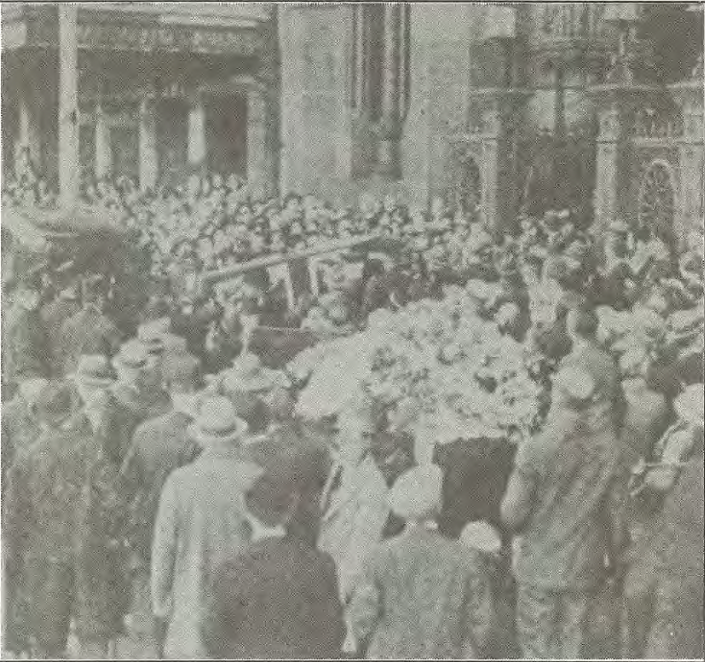
Rabbi Cohen died in April 1934. His funeral was one of the largest ever known in Sydney. Thousands stood outside the Great Synagogue, unable to be accommodated in the building; there were large numbers waiting along the Parramatta Road for the cortege to pass; and some estimates put the numbers who attended the graveside service at up to 3,000. Cohen’s visibility and articulateness as a Jewish leader and public figure led Jews to respect him even when they differed from his views, and brought him the admiration of leaders of the city, state and nation, as well as of fellow-citizens of all walks of life.[357]
His ministry in Sydney had commenced with immensely high hopes. After five years he was still optimistic even though he remarked,
It is not due to my people that I look, as I am told, and sometimes feel, considerably more than five years older than when I came, but to the difficult conditions under which they and I labour.[358]
The “difficult conditions” were rendered relatively tolerable because it was still a more or less homogeneous community. According to the author of a silhouette in the London Jewish World in 1913, he occupied his office with “a confidence that does not exhibit even a perceptible quaver,” and said he was genial to all; indeed it could speak of “the scintillating brilliancy of his graciousness.”[359] Twenty further years of difficulty in reconciling a diversifying community to his views and his authority told on him. Acknowledging a seventieth birthday tribute in 1932 he wrote:
I would ask you to be good enough to convey to the Board of Management my warm appreciation of the kindly thought which prompted its Members to so amiable and graceful a commemoration of my seventieth birthday. This was all the more valuable and welcome because since my return to constantly accumulating difficulties here after observing the freer hand advantageously given everywhere to my colleagues in similar positions overseas, I had been more than once tempted to say with Macbeth that
‘All that should accompany old age,
As honour, love, obedience, troops of friends,
I may not look to have.’The Board’s kind gesture of appreciation and good will has entirely reassured me. Coupled with so many other friendly and even gracious expressions which have since been showered upon me, it leaves me not only very grateful, but also strengthened and encouraged for what future activity remains to
Yours always sincerely,
FRANCIS L COHEN
Rabbi[360]
People’s perceptions of him were partly influenced by the impact his personality made on them. One recalls him as warm, humorous and sensitive, another as aloof, imperious and unsympathetic. The debates and disputes which surrounded his views did not entirely or even partially intrude upon the consciousness of very many families for whom he was a somewhat awesome but always benevolent figure whose ministrations in time of joy or sorrow were what they gratefully remembered. Many who heard his addresses, at Jewish or other gatherings, recall his dignity and diction without being too bothered to assess the validity of his views.
This study, however, cannot conclude without an endeavour at analysis of his thinking and approach in terms of Jewish self-perception. Cohen has been dubbed by some of his critics as an assimilationist whose policies would lead to the disappearance of Judaism. The problem of finding the right level of relationship with gentile society had become acute when the armies of Napoleon swept across Europe and the walls of the ghettoes crumbled. Emergence into the modern world threw many Jews off balance. One attempt to retain Jewish identity at the same time as integrating into society was to alter the Jewish image in order to remove or play down elements such as Jewish ethnicity which might hinder or frustrate the desired integration. The Jewish Reform movement went much further than did Cohen when it both removed ethnic elements from Judaism and also purged the prayer book of references to Zion and Messianism; when it both sought to make Jewish worship decorous and dignified and also removed the binding authority of Jewish law from the pattern of Jewish life. Cohen retained the traditional prayer book, though he endeavoured to make services aesthetically attractive; he remained loyal to Jewish law, though he attempted, on the whole, to interpret it leniently. But he shared the conviction that gentiles would remain suspicious of Jews and not fully accept them into general society if they appeared to be in some sense a national group with loyalties that might be thought inconsistent with citizenship of the land of their residence.
Assimilation to non-Jewish cultural patterns in matters of language, dress, etc., was taken for granted by Cohen’s critics, though in recent years some Jewish sects have attempted to resist even these superficial marks of acculturation. But it was a different type of assimilation which the critics found objectionable – the attempt to approximate the nature of Judaism to other religious groups and to argue that Judaism was neither more nor less than a religion (albeit an historically senior one) among religions.
The attempt to fit Judaism into a Procrustean bed and remove from it the dimension of peoplehood might be said to be, as Milton Steinberg says of the movement for Jewish emancipation as a whole, “the record of a continuous frustration.”[361] As far as Cohen was concerned, it might be said that, in three respects articulated by Steinberg, his dream was frustrated:
1. It was “the result of a servility of spirit.”[362] It implied that gentile ways were desirable and gentile disapproval to be avoided at all costs. Cohen himself had to admit that Jews had to retain (to paraphrase his own words) friendly independence of judgment.
2. It had to “gamble against a violent recrudescence of anti-Semitism.”[363] Even in friendly Australia, as he called it, integration into society was no guarantee of security, though compared to other places “Australia … has no significant history of anti-Semitism.”[364] The continuance of anti-Jewish feeling in other countries, and the emergence late in Cohen’s life of the Nazi movement, indicated that there were limits to the faith one could place in assimilation.
3. Internal as well as external developments could, and to an increasing extent did, reject the Cohen type of emphasis in favour of “some atavism … some throw-back to old Jewish loyalties.”[365] In Australia the post-war development of a multi-ethnic society has to a great extent quietened the old “dual loyalty” accusation and encouraged intense cultivation of Jewish commitment even at the expense of some measure of integration.
Nowhere, however, does Cohen entirely reject the existence of an ethnic element in Judaism, Nor indeed does he suggest that Palestine and Jewish re-settlement there lack significance and inspiration for the Jew. What concerns him most is the establishment and maintenance of an order of priorities in which religion will remain the crucial quality of Jewish identity, and religious teachers the authentic spokesmen and acknowledged leaders of the Jewish community. If the political Zionists are to be allowed to turn political action for a Jewish state into the major motivation of community life, and downgrade religion into an optional matter for the individual conscience, they will, he implies, take the soul and centre out of Judaism.
This question of emphasis explains why Cohen sometimes seemed anti-Zionist and at other times merely non-Zionist, prepared on such occasions to support practical projects in the Holy Land and to donate to Zionist appeals. Ben Halpern speaks of anti-Zionism as “not a constant but an episodic manifestation in Western Jewry.”[366] On occasions when the ethnic doctrine had been proclaimed particularly forcefully and the pre-eminence of religious-based institutions challenged, anti-Zionism arose as a response. But when the political emphasis in Zionism subsided – either because of a Zionist defeat or a widely recognised Zionist victory – the anti-Zionist tide ebbed and was replaced by the more neutral phenomenon of non-Zionism whereby someone like Cohen could support Zionist projects whilst claiming to be sitting on the fence.
Cohen’s basic assumption when so strongly arguing that a Jew must not compromise or fail to appreciate the blessings of British citizenship was not only that Britain had been good to Jews and self-interest dictated that nothing be done which might jeopardise the security of the group, but also that British ideals and the British ethos were admirable and could enrich and enhance Jewish culture. On the organisational level there is evidence that British Jewry utilised British models. Himmelfarb speaks of what he calls Heine’s Law. Heine was the reputed author of the witticism Wie es sich christelt, so judelt es sich, roughly translated, “Like Christian, like Jew.” Says Himmelfarb,
Without Heine’s Law, how could we explain the basically episcopal organisation of Judaism in Great Britain? … The Board of Deputies is another expression of that Englishness: it is English to have quasi-corporate religious communities with some internal authority, and with official or quasi-official relations with that State.[367]
On a deeper level Cohen believed that a creative synthesis of British and Jewish ideas and culture would benefit both; the encounter with British society would be fruitful for Judaism, and if in the process certain liturgical forms were recast to make them more decorous and aesthetic, that was not reform for reform’s sake but adaptation which in the long run would strengthen Judaism and its hold on its adherents. Cohen would have agreed with Cecil Roth that there is a difference between “clean” and “unclean” assimilation.[368] The latter attempts to submerge a minority culture completely so as to disappear into the majority culture, whereas the former holds on to the culture of the group but allows it to interact with the culture of the environment. Only in this “clean” sense would Cohen have called himself an assimilationist.
NOTES
INTRODUCTION
1. Francis Lyon Cohen (FLC) to president, 28 April 1904.
CHAPTER I
2. Harriet Cohen, A Bundle of Time, London, 1969, p.17.
3. Marriage Registers of the New Synagogue, London; the civil marriage certificate gives Woolf Cohen’s father as Moses Cohen, though this may be an error since the Hebrew document calls him Katriel.
4. Obituary of Harriet Cohen (press cutting, source and date not known).
5. Jewish Chronicle (hereafter JC), 27 June 1856, p.637.
6. ibid, 29 December 1871, p.7, etc.
7. ibid, 5 August 1864, p.5.
8. ibid., 12 October 1866, p.7.
9. Chief Rabbi to M Phillips, 28 February 1884.
10. Cecil Roth, Magna Bibliotheca Anglo-Judaica, London, 1937, etc.
11. United Synagogue Visitation Committee Minutes, 8 November 1897.
12. infra, ch.4.
13. Hebrew Standard (hereafter HS), 27 May 1910, p.7.
14. infra, ch.4.
15. JC, 10 March 1876, p.805.
16. Isidore Harris, History of Jews’ College, London, 1906, passim; Albert Montefiore Hyamson, Jews’ College, London, 1855-1955, London, 1955, passim.
17. Harris, Jews’ College, pp.cxcii-iii.
18. JC, 8 April 1904, p.18.
19. Harris, Jews’ College, pp.hex-iii.
20. JC, 18 February 1881, p .l.
21. Jewish World (hereafter JW), 8 April 1904, p.43.
22. Cecil Roth, The Great Synagogue, London, 1690-1940, London, 1950, pp.262-3, 269,293. 23. infra, ch.3.
CHAPTER 2
24. HS, 27 May 1910, p.7.
25. Bernard Shillman, A Short History of the Jews in Ireland, Dublin, 1945; Louis Hyman, The Jews of Ireland, London/Jerusalem, 1972.
26. Borough Synagogue Minutes, 10 January 1886; 4 April 1886.
27. Lady’s World, February 1887, pp.132-33.
28. Great Synagogue Congregational Journal, April 1952, p.7.
29. HS, 28 October 1910.
30. Morris Rosenbaum, History of the Borough Synagogue, London, 1917, p.24.
31. Vivian D Lipman, “The Rise of Jewish Suburbia”, in Transactions of Jewish Historical Society of England, vol.21 (1962-67), p .91.
32. Borough Synagogue Report, January 1886.
33. Lipman, “Jewish Suburbia”, p.91.
34. Rosenbaum, Borough Synagogue, p.7.
35. infra, ch.5; Anglo-Jewish tradition suggests that the patronage of the Duke of Cambridge helped Nathan Marcus Adler become Chief Rabbi in 1845.
36. Leviticus 21:1-4.
37. H Adler to Wardens, Borough Synagogue, 28 January 1886.
38. Numbers 6:22-27.
39. FLC to secretary, 8 January 1923.
40. FLC to president, 17 November 1922.
41. Australian Jewish Chronicle (hereafter AJC), 5 February 1925, p.6.
42. Lipman, “Jewish Suburbia”, pp.97-98.
43. Raymond Apple, The Hampstead Synagogue, 1892-1967, London, 1967, pp.50, 109.
44. JW, 8 April 1904, p.43.
45. infra, ch.3.
46. infra, ch.4.
47. JC, 8 April 1904, p.18.
48. e.g. JC, 27 May 1892, p .12.
49. Jewish Encyclopaedia, 12 vols., New York, 1904, vol.7, s.v. “Jewish Lads’ Brigade”.
50. Sidney Salomon, The Jews of Britain, London, 1939, p.66.
51. FLC to president, 3 August 1904.
52. Borough Synagogue Minutes, 13 July 1891.
53. Olga Somech Phillips and Hyman A Simons, The History of the Bayswater Synagogue, 1863-1963, London, 1963, passim.
CHAPTER 3
54. JC, 8 April 1904, p.18.
55. Harris, Jews’ College, p .clxviii.
56. Apple, Hampstead Synagogue, p.21.
57. Chief Rabbi’s Office to Synagogues, 28 November 1887.
58. Published London, 1899, and often reprinted.
59. infra, ch.6.
60. JW, 18 October 1889.
61. JC, April 1904, pp.20-21.
62. Lazare Saminsky, Music of the Ghetto and Bible, London, 1934, p .212.
63. HS, 19 April 1907, p.8.
64. JC, 8 April 1904, p.19.
65. Alfred Kalisch, “The Jew and His Music”, in H Newman (ed), The Real Jew, London, 1925, p.231.
66. Isidore Freeman in Jewish Guardian, 24 April 1931.
67. AJC, 23 July 1925, p .12.
68. infra, ch.10.
CHAPTER 4
69. United Synagogue Visitation Committee Minutes, 4 May 1892; 13 March 1893.
70. Borough Synagogue Annual Report, April 1893; Cohen’s actual title, approved in October 1892, was Jewish Officiating Chaplain: JC, 22 April 1904, p.10.
71. JC, 18 Aptil 1904, p.18.
72. JW, 15 October 1897, p.37; HS, 27 May 1910, p.7.
73. Cecil Roth, “The Jews in the Defence of Britain”, in Trans. JHSE, Vol.15 (1939-45), pp.1-28; Lionel Simmonds, “For Sovereign and Country”, JC, 27 April 1956, p.19.
74. JC, 22 April 1904, p .10.
75. ibid., 22 April 1904, p.10.
76. ibid., 25 January 1895, p.10.
77. Daily Chronicle, 9 December 1901.
78. Daily Telegraph, 25 December 1905.
79. infra, ch.8.
CHAPTER 5
80. HS, 8 February 1907, p.8.
81. Israel Porush, The House of Israel, Melbourne, 1977, ch.7.
82. JC, 8 April 1904, p.19.
83. FLC to BW Levy, 27 March 1904.
84. Borough Synagogue Minutes, 6 April 1892.
85. ibid.
86. Apple, Hampstead Synagogue, pp.21-23; A May to Borough Synagogue board of management, 18 August 1899.
87. infra, ch.9.
88. FLC to president, 3 August 1904.
89. Israel, May 1899, p.31.
90. Hermann Gollancz, Personalia … , Oxford, 1928, p.25.
91. JC, 1 July 1904, p.19.
92. ibid.
93. JC, 8 July 1904, p.21.
94. ibid., 15 July 1904, p.18; 22 July 1904, p.18.
95. FLC to BW Levy, 31 July 1904.
96. FLC to president, 3 August 1904.
97. FLC to BW Levy, 30 March 1905; Chief Rabbi to BW Levy, 3 April 1905.
CHAPTER 6
98. JC, letters from AMH and D Hudaly, 1 August 1947.
99. Stephen Sharot, “Religious Change in Native Orthodoxy in London, 1870-1914: The Synagogue Service”, Jewish Journal of Sociology (hereafter JJS), vol.15, no.l (1973), pp.57-78.
100. GM. Trevelyan, English Social History, London, 1948, p.508.
101. JC, 12 January 1849.
102. Porush, House of Israel, pp.28-29.
103. FLC to president, 8 October 1928.
104. infra, ch.10.
105. HS, 1 March 1907.
106. ibid., 24 August 1906, p.3.
107. President to FLC, 17 July 1922.
108. FLC to president, 18 July 1922.
109. infra, ch.7.
110. HS, 4 December 1908.
111. ibid., 15 January 1909.
112. ibid., 12 August 1910.
113. AJC, 10 January 1924.
114. ibid., 7 February 1924.
115. ibid.
116. HS, 26 February 1909.
117. Israel Getzler, Neither Toleration nor Favour: The Australian Chapter of Jewish Emancipation, Melbourne, 1970, passim.
118. HS, 27 April 1923, p.2.
119. infra, ch.7.
120. FLC to secretary, 19 November 1931.
121. JW, 10 December 1913, p.11.
122. infra, chs 9 and 10.
123. Discourse.
124. Popular expositor of traditional books.
125. HS, 28 September 1906, p.7.
126. AJC, various issues in 1924.
127. ibid., 21 August 1924, p.6.
128. FLC to president, 17 November 1922.
129. MH Kellerman, History of N.S.W. Board of Jewish Education, Sydney, 1979, p.226.
130. infra, ch.7.
131. ibid.
132. FLC to president, 27 January 1922.
133. AJC, 3 May 1925, p.l.
134. HS, 8 February 1907, p.3.
135. ibid., 12 February 1909.
136. AJC, 16 October 1924, p.12.
137. ibid., 13 December 1923, p.11.
CHAPTER 7
138. President to board, 31 October 1921.
139. HS, 1 March 1907.
140. FLC to president, 14 April, 1924.
141. FLC to president, 23 May 1922.
142. FLC to president, 15 October 1922.
143. FLC to president, 26 January 1922.
144. Charles A Price, “Jewish Settlers in Australia, 1788-1961 “, Australian Jewish Historical Society Journal (hereafter AJHS), vol.5, part 8 (1964).
145. HS, 17 and 24 November 1917.
146. AJC, 10 July 1924, pp.6-7.
147. FLC to president, 14 April 1924.
148. AJC, 18 September 1924, p.10.
149. Suzanne D Rutland in Australian Dictionary of Biography, vol.8 (1891-1939), p.52.
150. FLC to president, 17 September 1922.
151. AJC, 31 March 1927, p.14.
152. ibid.
153. FLC memorandum, 5 January 1932.
154. FLC memoranda, 26 June and 3 and 6 July, 1932.
155. President to FLC, 15 November 1928.
156. FLC to president, 5 May 1920.
157. FLC to president, 23 February 1920.
158. ibid.
159. FLC to acting president, 11 August 1932.
160. President to FLC, 6 December 1909.
161. FLC to president, 9 December 1909.
162. President to FLC, 13 December 1909.
163. FLC to president, 10 March 1929.
164. President to FLC, 11 March 1929.
165. FLC to president, 12 march 1929.
166. President to FLC, 7 August 1929.
167. FLC to president, 8 August 1929.
CHAPTERS 8
168. HS, 8 February 1929, p.3; 31 October 1930, p.7.
169. AJC, 5 February 1925, p.l.
170. Suzanne Rutland, Seventy-Five Years: the History of a Jewish Newspaper, Sydney, 1970, p.48.
171. Leslie Caplan in Australian Jewish Times, 1 December 1983, p .13.
172. HS, 28 April 1933.
173. AJC, 24 July 1924, p.2.
174. Patrick O’Farrell, The Catholic Church and Community in Australia, 1977, p.321 etc.
175. HS, 28 August 1908.
176. ibid., 30 May 1924, pp.1-2.
177. ibid., 3 September 1909.
178. AJC, 18 September 1924, p.10.
179. HS, 4 August 1911, pp.3 and 9.
180. Pentecost; anniversary of the giving of the Ten Commandments, and barley harvest in ancient Israel.
181. AJC, 23 June 1927, p.7.
182. infra, eh. 10.
183. AJC, 14 May 1925, p .11.
184. ibid., 12 May 1927, p .12.
185. ibid.; Rutland, Seventy-Five Years, p.17.
186. A Fabian, “Jewish Chaplaincy in Australia”, AJHS, vol.6; part 6, pp.344-55.
187. HS, 6 January 1911, p .4.
188. AJH, 6 January 1911, p .39.
189. FLC to president, 18 August 1910.
190. HS, 6 August 1915, p.l.
191. Fabian, “Jewish Chaplaincy”, loc.cit.; HS, 12 January 1917, pp.5-7.
192. Michael McKernan, Australian Churches at War, Sydney/Canberra, 1980, pp.90-91, 110.
193. HS, 30 July 1915, p.3.
194. FLC to president, 10 March 1929.
195. HS, 3 December 1909.
196. ibid., 8 July 1910.
197. FLC to president, 20 June 1910.
198. FLC to president, 12 February 1931.
199. AJC, 14 May 1925.
200. HS, 4 December 1908.
201. Ernest Cohen and Linton, solicitors, to secretary, 23 May 1922.
202. HS, 1 October 1909.
203. FLC to president, 12 February 1931.
204. HS, 1 February 1924, pp.1-2.
205. ibid., 27 April 1923, pp.1-2.
206. AJC, 10 January 1924, p.12.
207. ibid., 7 February 1924, p.l.
208. e.g. ibid., 24 January 1924, p.7; 7 February 1924, p.8.
209. ibid., 24 July 1924, p.2.
210. ibid., 21 February 1924.
211. Rutland, Seventy-Five Years, p.28.
212. Price, “Jewish Settlers”, appendix XI.
213. AJC, 15 November 1923, p.11.
214. supra, ch.6.
215. FLC to president, 16 January 1922.
216. FLC to president, 14 April 1924.
217. FLC to president, 16 January 1922.
218. FLC to president, 12 February 1931.
219. ibid.
220. ibid.
CHAPTER 9
221. Israel Zangwill, Children of the Ghetto, London, 1892, book 2, ch.9.
222. Bernard Homa, A Fortress in Anglo-Jewry, London, 1953, passim.
223. Claude Goldsmid Montefiore, The Origin and Growth of Religion as Illustrated by the Religion of the Ancient Hebrews, Hibbert Lectures, London, 1892.
224. HS, 6 April 1906, p.3.
225. ibid., 6 November 1908.
226. ibid., 1 July 1910.
227. ibid., 22 February 1907, p .10.
228. ibid., 22 January 1909.
229. FLC, The Spiritual Significance of the Kosher Table, reprinted from HS, Sydney, 1905.
230. AJC, 30 April 1925, p.l.
231. Anniversary of a relative’s death.
232. FLC to president, 3 August 1910.
233. FLC to secretary, 19 November 1931.
234. FLC to president, 16 November 1922.
235. FLC to president, 19 July 1929.
236. AJC, 15 June 1922, p.5.
237. FLC to president, 12 March 1931.
238. FLC to president, 15 May 1922.
239. FLC to president, 31 October 19 10.
240. FLC to president, 19 May 1922.
241. HS, 7 September 1906, p.3.
242. Immanuel Jakobovits, “Jewish Law Faces Modern Problems”, in Leon D Stitskin (ed), Studies in Torah Judaism, New York, 1969, pp.357-60.
243. Isaac Levy, The Synagogue: its History and Function, London, 1963, pp.59-63.
244. Apple, Hampstead Synagogue, pp.22, 106.
245. Sydney Herald, 19 April 1842, quoted by ZZ, HS, 14 September 1906, p.9.
246. Marie Keysor, in AJHS, vol.1, part 8 (1942), p.271.
247. AJC, 29 June 1922, p.5.
248. ibid., 13 July 1922, p.5.
249. Newcastle Synagogue Jubilee, 1927-1977, p.9.
250. AZ ldelsohn, Jewish Music in its Historical Development, New York, 1948, p.244.
251. Rosenbaum, Borough Synagogue, p.24.
252. Olga Somech Phillips and Hyman A Simons, The History of the Bayswater Synagogue, 1863-1963, London, 1963, p.17.
253. Chief Rabbi to president, 12 July 1922.
254. FLC to president, 27 November 1928.
255. Report on the Sabbath Reading of the Scriptures in a Triennial Cycle, New West End Synagogue, London, 1913, pp.4-8.
256. loc.cit., pp.18-19.
257. FLC memorandum on Revision of the Ritual, 21 June 1922.
258. President to Chief Rabbi, 7 December 1921.
259. Chief Rabbi to president, 12 July 1922.
260. FLC to president, 16 November 1922.
261. FLC to president, 25 November 1928.
262. Sephardi = lit., Spanish; denotes Eastern, Oriental.
263. See commentaries on Day of Atonement liturgy, e.g. Herman Kieval, “The Paradox of Kol Nidre”, in Philip Goodman (ed.), The Yom Kippur Anthology, Philadelphia, 1971, pp.84-98.
264. FLC to president, 12 February 1931.
265. Sir Isaac Isaacs; for controversies surrounding his appointment, see Zelman Cowen, Isaac Isaacs, Melbourne, 1967, ch.8.
266. Machzor – festival prayer book.
267. FLC to secretary, 19 July 1931.
268. Kieval, “The Paradox of Kol Nidre”, op.cit., pp.92-93.
269. FLC to secretary, 19 July 1931.
270. Secretary to Chief Rabbi, 29 February 1932.
271. JH Hertz (ed.), The Pentateuch and Haftorahs, 1-vol. edn., London, 1952, pp.730-31.
272. Chief Rabbi to secretary, 13 July 1932.
273. FLC note, 7 September 1932; secretary to FLC, 16 September 1932.
274. FLC to president, 16 February 1933.
275. FLC memorandum, 19 May 1922.
276. AJC, 28 December 1922, p.2.
277. cf. JC, 20 May 1892, p.5.
278. Rutland, Seventy-Five Years, pp.20-23.
279. AJC, 29 June 1922, p.2.
280. Cremation is forbidden in Jewish law; cf. FLC to president, 12 May 1925; 25 June 1925.
281. He is said to have been “often in minority but never shaken … fearless in attack and strong in defence”; cf. Joseph Herman Hertz, 1872-1946, In Memoriam, London, 1947, pp.14, 31.
CHAPTER 10
282. Resolution of first Zionist Congress, Basle, Switzerland, 1897.
283. Hermann Adler, Religious versus Political Zionism, sermon at North London Synagogue, London, 1896, pp.8-16; cf. Raphael Patai (ed.), Encyclopaedia of Zionism and Israel, 2 vols., 1971, s.v. “Anti-Zionism”.
284. HS, 26 June 1903.
285. Alan D Crown, “The Initiatives and Influences in the Development of Australian Zionism, 1850-1948”, Jewish Social Studies, vol.39, no.4, pp.304 etc.
286. AJH, 25 April 1902, pp.145-46.
287. HS, 18 November 1904, p.4. 288. ibid., 14 July 1905.
289. Suzanne Rutland, Seventy-Five Years, passim.
290. AJC, 25 June 1925, p.l; Rutland, Seventy-Five Years, ch.4.
291. Crown, “Initiatives and Influences”, p .306.
292. HS, 1 March 1907.
293. MZ Forbes, “Early Zionism in Sydney, 1900-1920”, AJHS, vol.3, pt.4 (1950), p.178.
294. op. cit., pp.179-80.
295. op. cit., p.182.
296. He was the Sydney treasurer for an appeal for a Talmudical college in Jerusalem and signed a manifesto entitled, “A Heartrending Cry to Australian Jewry from the Holy City.”
297. AJH, 20 January 1911, p.43.
298. ibid., 1 March 1912, p.101.
299. FLC (and John Coulston) to president, undated (probably January 1922).
300. AJC, 27 November 1924, p.12.
301. Israel Cohen, The Journal of a Jewish Traveller, London , 1925, pp.60-64.
302. HS, 10 April 1925, p.5.
303. ibid., 16 November 1917.
304. ibid., 30 November 1917, p.4; Israel Cohen, Jewish Traveller, p.62.
305. Times, 28 May 1917; Stuart A Cohen, “The Conquest of a Community: the Zionists and the Board of Deputies in 1917”, Jewish Journal of Sociology, vol.19, no.2 (1977), pp.157-184.
306. JH Hertz, Sermons, Addresses and Studies, 3 vols., vol.2, London, 1928, pp.357-60.
307. Sir Matthew Nathan.
308. FLC to president, 10 June 1923.
309. FLC to president, 6 August 1923.
310. AJC, 30 November 1922, p.6.
311. ibid., 5 April 1923, p.l etc.
312. Rutland, Seventy-Five Years, chs.4-5.
313. David Polish, Renew our Days: the Zionist Issue in Reform Judaism, Jerusalem, 1976, passim.
314. Ben Halpern, The Idea of the Jewish State, Harvard, 1969, p.144.
315. AJC, 23 July 1925, p.14.
316. ibid., 28 May 1925, p.2.
317. Israel’s Messenger, quoted in AJC, 22 March 1923, p.2; Klal Yisrael = the Jewish people.
318. Korah led a rebellion against Moses and Aaron.
319. AJC, 25 June 1925, p.13.
320. Crown, “Initiatives and Influences”, p .309.
321. AJC, 6 September 1923, p.6.
322. Zionist leader; Great Synagogue honorary officer.
323. Told to me by Falk’s son.
324. Told to me by Falk’s son.
325. HS, 27 May 1932, p.3.
326. Max Freilich, Zion in our Time, Sydney, 1967, p.15.
327. op.cit., p .3.
328. FLC to president, 2 August 1927.
329. AJC, 27 November 1924, p.12; cf. Stuart A Cohen, English Zionists and British Jews: the Communal Politics of Anglo-Jewry, 1895-1920, London, 1983, passim.
330. AJC, 27 November 1924, p.12.
331. HS, 8 and 15 February 1929.
332. AJC, special issue, 21 November 1928, p.1.
333. HS, 8 February 1929, p.3.
334. FLC to president, 28 August 1929.
335. In a communication to me.
336. Aide memoire by secretary, 4 September 1929.
337. Secretary to FLC, 5 September 1929.
338. Secretary, Australian Zionist Federation, to president, 24 September 1929.
339. FLC to president, 26 September 1929.
340. Petition to president, 16 October 1929.
341. Note attached to petition to president, 16 October 1929.
342. Illuminated address to FLC, 17 June 1930.
343. John Goulston to president, 27 October 1930.
344. Freilich, Zion, p.17.
345. op.cit., pp.17-18.
346. FLC to president, 6 April 1932.
347. Crown, “Initiatives and Influences”, p.314.
348. Freilich, Zion, p.56.
349. EM Levy letters in Great Synagogue archives.
350. Haham = Sage, Chief Rabbi.
351. Selig Brodetsky, Memoirs: From Ghetto to Israel, London, 1960, p.193.
352. Michael Wallach, “Voices of Dissent”, JC, 10 September 1982.
353. Gustav Saron and Louis Hotz (eds.), The Jews in South Africa, Oxford, 1955, esp. ch.14.
354. LM Goldman, The History of the Jews in New Zealand, Wellington, 1958, ch.28.
355. Jacob Danglow to Harris M. Lazarus (London), 7 July 1920; letter in my possession.
356. Louis I Rabinowitz, “The End of an Era”, AJH, 20 July 1962.
CHAPTER 11
357. Telegraph, 30 April 1934.
358. HS, 27 May 1910, p.7.
359. JW, 10 December 1913, p.11.
360. FLC to president, 21 November 1932.
361. Milton Steinberg, The Making of the Modern Jew, New York, 1967, p.243.
362. op.cit., p.241.
363. op.cit., p.233.
364. Marshall Sklare, introduction to PY Medding, From Assimilation to Group Survival, Melbourne, 1968, p.xx.
365. Steinberg, Modern Jew, p.233.
366. Ben Halpern, The Idea of the Jewish State, Harvard, 1969, pp.132-33.
367. Milton Himmelfarb, “Our Jewish Community Pattern and its Critics”, Commentary, August 1953, pp.117-18; cf. Stephen Sharot, “Religious Change in Native Orthodoxy in London, 1870-1914: Rabbinate and Clergy”, JJS, vol.15, no.2 (1972), pp.168, 174, 176-77.
368. Cecil Roth, “England, the Ideology of an Assimilated Jewry”, Anglo-Jewish Association Quarterly, December 1957, p.l; cf. Rebecca Scherer, “‘Creative Assimilation’ and its Benefits”, Jewish Digest, December 1982, pp.12-1


