May 10th, 2026
Q. I know why Judaism disagrees with Christianity and Islam, but what does it say about Buddhism and Hinduism?
 A. It rejects the negativism of Buddhism, the idea that you and I and the entire universe are nothing: When something in life goes wrong we cannot handle it or respond; we can only withdraw.
As against Buddhism, which in most versions is a non-theistic “way”, Judaism is a way of life given by and answerable to the Creator God.
In regard to Hinduism, one of our major problems is not that it lacks a god but that it has too many of them. Judaism regards it as idolatrous despite its moral principles.
 Posted by oztorah |
  Ask The Rabbi, Gentiles & Other Faiths |
  Permalink
May 10th, 2026
 No explicit date is given in the Torah for Shavu’ot. We know it has to come seven weeks after Pesach.
In Second Temple times it was hotly debated between the Pharisees, who said that in the command to count seven weeks “from the morrow of the Sabbath”, “Sabbath” means the first festival day of Pesach – and the Sadducees, who said that “Sabbath” means Saturday. The Pharisee view prevailed, so the two festivals are intrinsically linked.
The outcome is that the physical freedom of Pesach, when the people became an independent nation, is complemented by the moral freedom of Shavu’ot, when they decided that they would accept the Torah as their national constitution.
Posted by oztorah | Festivals & Fasts, Shavu'ot | Permalink
May 10th, 2026
 Shavu’ot is marked by eating dairy foods.
The explanations for this custom are almost innumerable. Every book about Jewish practice and custom offers a theory.
One of the possibilities is the following.
In the laws of kashrut, it is prohibited to mix milk and meat foods. The prohibition comes three times in the Torah, so that the separation of the two categories of food is a crucial sign of Jewish observance. Yet milk is permitted on its own, as is meat (provided of course it is kosher), but what is not permitted is their mixture.
The Torah portion of No’ach, with its Seven Laws of the Sons of Noah, tells us that we may not consume meat that is torn from the body of a living animal (Ever Min HaChai). Meat therefore is only allowed if the animal has been properly slaughtered (using the laws of shechitah). Milk, on the other hand, comes by definition from a living animal.
In case one thought that the rule against meat from a living animal also entailed not consuming milk from a living animal, the Jewish tradition specially ordained an occasion – Shavu’ot – which features and celebrates the eating of milk products.
Posted by oztorah | Festivals & Fasts, Shavu'ot | Permalink
May 3rd, 2026
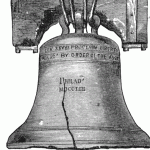 “Proclaim liberty in the land to all its inhabitants” (Lev. 25:10).
These words from the sidra are part of American history. They figure on the Liberty Bell in Philadelphia.
They are noble words. But if one looks at them in detail, they raise a number of questions.
The P’nai Yehoshua asks why the Torah says yosh’veha, “its inhabitants” and not avadeha, “its servants”.
The answer is that it is not only servants who need freedom – everyone does. Even if you have freedom, you have to learn how to value your freedom.
If you do not appreciate freedom, or peace, or health, or family, or any other blessing you may have, it is as if you have lost them.
Many commentators focus on the word used for freedom in this verse, d’ror.
Rashi quotes Rabbi Yehudah who links it with dirah, a dwelling. “Why the expression d’ror? To show that freedom is when you may choose where to dwell without others compelling you”.
According to the dictionaries the root of the word is darar, to stream or flow abundantly; hence d’ror is the free run that comes with freedom.
D’ror also means a swallow (see Psalm 84:4). The Talmud explains (Shabbat 106b) that the swallow is a bird that does not yield to capture or taming and “it lives in a house as in the field”.
Posted by oztorah | B'har, Parashah Insights | Permalink
May 3rd, 2026
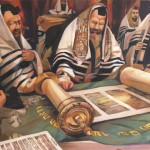 The Reader lowers his voice for the Tochechah. No-one should get the idea that he enjoys enunciating the threats of punishment that come from disobedience.
Even though the congregation realise that they are not his words but God’s, there is still the risk that someone will say, “I noticed that at a particular point he looked straight at me and raised his voice. He was obviously telling everyone that that particular verse was written with me in mind!”
The fact is that we do sometimes quote a nasty passage from somewhere and apply it to someone we want to criticise. It is not a nice habit, but it happens.
There actually is an antidote to this attitude hinted at in the Tochechah. There are blessings as well as curses.
The lesson is that no-one is entirely bad. Nor for that matter are they entirely good. They are not as bad as you think they are. Nor are they as good as they themselves think they are.
This applies to ourselves – not only to others. How are you or I to judge ourselves? We are not as bad as we fear or as good as we imagine.
This may also be a good way to judge events and situations, to say things are both better, and worse, than they appear to be.
Posted by oztorah | B'chukkotai, Parashah Insights | Permalink


