The fast train to nowhere

September 18th, 2023

The Torah reading for Yom Kippur is probably the origin of the habit of casting blame on others.

Sins committed in the Israelite community were transferred to a goat which was sent out into the wilderness (Lev.16; Mishnah Yoma 6:4). The high priest drew lots LaShem, “for God” and La’Azazel, “for despatch into the wilderness”.

What did Azazel mean? Maybe it indicated the goat, maybe the destination in the wilderness.

If it is a place, the terrain was hard and rocky; in folklore it is a place to which two fallen angels, Uzza and Aza(e)l, were banished because they had besmirched the Creation.

If the name indicates the goat, it possibly denotes “the one that goes” (in the Septuagint, “the sent-away one”).

Various Midrashim think it symbolises a power opposed to God. These sources, plus the Dead Sea Scrolls, say that in the end all the negative forces in the world will be overcome and destroyed.

Maimonides (Moreh Nevuchim 3:46) regards the “scapegoat” procedure as symbolic: in order to eradicate all trace of sin it suggests despatching it to a distance (an example of “put it on a fast train to nowhere”).

Unfortunately, transferring blame somewhere else is a prevalent habit, “passing the buck”, accusing the other of doing things for which we ourselves are responsible.

The best approach is the Talmudic story of Elazar ben Durdaya (Avodah Zarah 17a) who after trying the scapegoating approach and blaming heaven and earth, night and day, came to the honest conclusion, “My fate depends on me myself”.


Out of the woodwork

September 18th, 2023

Yom Kippur always brought great crowds to the synagogue. The numbers swelled even more when the time came for Yizkor and people came out of the woodwork, so to speak.

Even people who claimed to be atheists who are angry with God or question His existence found their way to their people and its memories.

The origin of the Yizkor ceremony derives from the Torah reading which depicts events “after the death of the sons of Aaron” (Lev. 16:1). The reference to the death of our ancestors gave rise to the idea that memorial prayers should be said by people who are bereaved, regardless of how long ago the death took place.

I know that some people whose parents are still (Baruch HaShem) alive tend to go out of the synagogue when the memorial prayers are said. It is a practice that really has nothing to commend it. It would be much better for people to stay in the synagogue and give thanks for the blessing of having parents alive.

Likewise it would be better to stay in the synagogue and say a prayer for the martyrs whose lives were lost in the destruction of European Jewry or in defence of the State of Israel.

If you say, “My father wasn’t such a tzaddik: why bother with his memory?” Maybe in God’s eyes your father was one of the 36 hidden saints, even though you yourself might be unaware of his value to Heaven…


“A man’s reach should exceed his grasp, or what’s a heaven for?”: Rosh Hashanah and the aspiration for the world to come

September 15th, 2023

The following article by Rabbi Raymond Apple appeared on the ABC Religion and Ethics website on 14 September, 2023.

Every people has its own new year celebration, and every new year celebration has its characteristic sound. In some cases, the dominant note is rejoicing, in others hilarity; for the Jews it is a call to solemn soul-searching.

For Rosh HaShanah, the Jewish New Year, which will be observed this weekend, is Yom Hadin — the Day of Judgment on which God subjects His creatures to scrutiny and examination. It is an annual foretaste of that other Day of Judgment which will confront each of us as he knocks at the entrance to heaven and seeks admittance into the world to come.

On that day, say the Jewish sages, four questions are put to each man as he stands at the gateway to heaven:

Nasata v’natata b’emunah? — “Were your dealings with other people honest and clean?”
Kavata ittim latorah? — “Did you set aside time for Torah?”
Asakta b’fir’yah v’riv’yah? — “Did you promote marriage and family life?”
Tsipita liy’shu’ah? — “Did you keep faith, and hope for salvation?”

On the day of the final account and reckoning when you want to know, “Do I deserve the heavenly life of the next world?” you will be asked by means of these questions, “Did you aspire towards heaven in this world?”

The Yiddish writer, IL Peretz, tells the story of the Rabbi of Nemirov whose life on earth raised him heavenwards. During the solemn days just prior to the New Year, the Rabbi of Nemirov would sometimes vanish. He was not in the synagogue, he was not in the house of study, he was not at home; he was nowhere to be found. The simple folk of Nemirov were not at all concerned: for, they thought, where should the Rabbi be, with the New Year and the awesome Day of Atonement so close, but up there in heaven arranging matters with the Almighty?

But there was a stranger in town, and he was sceptical. He decided he would find out the truth. Where indeed did the Rabbi go? Hidden in the Rabbi’s house, he kept watch all night. Then he saw, before it was yet dawn, how the Rabbi rose from his bed, put on peasant costume, and crept stealthily out of town. The stranger followed him, and was amazed to see the Rabbi chop down a small tree in the woods, bundle up the logs, and return to town to a tumbledown old house where lived a poor, sick old woman.

There, pretending to be nothing more than a simple peasant who had brought her some wood, he laid the wood in the stove, carefully lit the fire, and as the warmth began to spread, he hummed and sang to himself the penitential hymn: “The soul is Thine, and the body is Thy handiwork: Have pity upon Thy creatures…”

When the warmth of the fire filled the room comfortably, he shut the stove, quietly left the house, and made his way back home before anyone was yet stirring in the streets. And ever afterwards, if people should tell how the Rabbi early each day raised himself and flew up to heaven, the erstwhile sceptic would say quietly, “To heaven? If not even higher…”

In Jewish teaching, the way of attaining heaven is not a simple matter of having the right ideas and beliefs. No, it is a much harder way. Ideas and beliefs come into it, but above all it involves living a life that will bring heaven down to earth and make earth into a heaven. The stranger in the little town of Nemirov was right: a person whose life is devoted to the quiet doing of good deeds is already, in a sense, in heaven, if not even higher.

But all this is so quaint and poetical that one feels the need of something more specific and practical. What then is the specific, practical recipe for heaven? The sages provide it with their four questions.

The first question

The first question stresses ethical living: Nasata v’natata b’emunah? — “Were your dealings with other people honest and clean?”

The Psalmist put it this way: “Who shall ascend the mountain of the Lord, and who shall stand in His holy place? He that has clean hands and a pure heart …” (Psalm 24:3–4) — which is to say, the one whose acts and attitudes are upright and honourable.

But make no mistake about it. To stand in all situations for the ethical approach, to insist on truth and honesty and justice at all times, requires considerable courage. A stand for conscience does not automatically make one popular. Insistence on integrity does not automatically bring material rewards. Often one stands almost alone.

But on the final Yom Hadin, the day of judgment, it will not help to claim that if one took the easy way out and compromised conscience, there were, after all, many others who did the same thing. For the Machzor, the New Year prayerbook, informs us that, on this day, “all who enter the world dost Thou cause to pass before Thee like a flock of sheep”. And, say the commentators, like sheep which pass for inspection one by one before their shepherd, so must every individual soul pass muster and separately answer how he has spent his life.

The second question

Kavata ittim latorah? is the sages’ second question: “Did you set aside time for Torah?”

In one sense the question is framed poorly, for surely religion is not merely a matter of certain time-slots of limited duration, but rather a way of believing, thinking, acting and re-acting, every hour of every day. But in another sense the question shows amazing insight. For it can also be understood in this way: did you set the times towards Torah — did you help to mould your era in history in a religious way?

The days have gone when Bible and religion dominated most people’s lives. Yet, paradoxically, for all the evidences of a rapidly diminishing of religious commitment, there are at the same time signs of intense interest in faith, spirituality, mysticism, meditation, and practices of devotion.

There is no mass return to synagogue or church, to organised religion. But there is an awakening of yearnings which are religious in the deepest sense of the word. There may not be vast numbers suddenly assenting to traditional dogmas or observing traditional rituals, but there is a growing conviction that human beings need a God and a set of values based on eternal verities. It has taken a long while, but responsible people are today searching for values and standards upon which to reconstruct society and ensure its survival.

The third question

Asakta b’fir’yah v’riv’yah? — “Did you promote marriage and family life?”

This may be an annoying question for a permissive, selfish, cynical society which tends to dismiss marriage and the family as outmoded and unexciting. No-one denies that some marriages and some families have their drawbacks: but what is good and creative and inspiring in the twin institutions of marriage and the family is far more significant.

Human beings need the assurance of commitment, loyalty, security, and social approval, as well as the inspiration to reveal one’s capacity for love and concern and personal challenge, which comes with a fulfilling marriage. Society needs a hinterland of harmonious human relationships, made up of good marriages and homes, to give it strength and stability; and marriage and the family also provide a secure base to enable outward-looking service to the larger community.

Nothing is more important in terms of human happiness and social cohesion than to strengthen marriage and the family. No investment is more worthwhile than the provision of education for marriage and parenthood, and of counsel and support in establishing and maintaining good family relationships.

The fourth question

The sages’ final question: Tsipita liy’shu’ah? — “Did you keep faith, and hope for salvation?”

This is an age of tension, fear, uncertainty, and pessimism. So much has gone wrong in the last 120 years that it is no wonder that Will Herberg, writing in the aftermath of the Second World War, could remark that “everything modern man has touched has turned to ashes”.

Who does not experience moments of depression and despair when we survey the world of today? Who can be certain that they or their family or their descendants will survive the threats that hover over humankind? The world stumbles from one crisis to another. One step leads to the next, and a cold, heartless fate seems to drive onwards the inexorable course of events.

But in case all this would leave one a despondent fatalist or a cynical pessimist, the sages gently advise us never to lose hope or to cease to work for the coming of better days.

The Midrash, a vast storehouse of rabbinic commentary and wisdom, asks the question, “Whom did God recognise as His most devoted and loving servants, out of all the saints and scholars who have served Him in all, ages and lands?” And it replies: His greatest servants were among the enslaved Israelites in Egypt, the contemporaries of Moses, that sorry band of men and women broken in body but not in spirit, who despite all their degradation never lost faith but looked forward to salvation.

The Midrash is an ancient work, and it therefore makes no mention of the men and women of faith who hoped against hope in many a subsequent century. But it tells us something symbolic, that the faithful never gives in to dark gloom or despair. They say with the Psalmist: “Though I walk through the valley of the shadow of death, I will fear no evil — for Thou art with me; Thy rod and staff, they comfort me” (Psalm 23:4). They says with their fellow human being whose name we shall never know, who scrawled on the wall of a cellar in Cologne while hiding from the Nazis:
“I believe in the sun — even when it is not shining.
“I believe in love — even when I do not experience it.
“I believe in God — even when He is silent…”

Ani ma’amin b’emunah sh’leimah, “I believe with perfect faith in the coming of the Messiah, and though he tarry I wait daily for his coming.” These are the words of the traditional Jewish proclamation of unquenchable faith in the coming of the age of redemption, and in the capacity of man to work towards it.

With the approach of Yom Hadin, the day of judgment, we do well to ponder on the sages’ four questions. We also do well to take to heart the story of the Rabbi of Nemirov.

Were the sages utopian idealists, setting out criteria that were idealistic but irredeemably impractical? Was the Rabbi of Nemirov merely a saintly fool, great in piety but hopelessly impractical? Is his high level of selfless spirituality somehow not for us?

I wonder. Surely Robert Browning was right: “A man’s reach should exceed his grasp, or what’s a heaven for?” Surely the purpose of Rosh Hashanah, the New Year, is that we raise our sights to heaven, that we aspire upwards, even though we may never entirely succeed in attaining our ideals and seeing all our visions come true.

It is my fervent hope that Rosh Hashanah, the dawn of a new chapter in human time, will mark too the dawn of a new and enduring phase in human living — a time of freedom for humanity; of peace everywhere, but especially between Israel and her neighbours: of truth and honesty in the dealings of human beings with one another, and of nation with nation. For that is what it would mean for heaven to come down to earth.


Teshuvah is for everyone

September 10th, 2023

No moment in Jewish history was as breathtaking as the revelation at Sinai. At that moment a slave rabble became a people of prophets. No one was unmoved and untouched by the experience.

What brought them to this historic peak?

The answer may be found in God’s words, “And I carried you on eagles’ wings and brought you to Me” (Ex.19:4).

A great experience bears a person aloft with a feeling of consuming exhilaration.

Read the passage in Herzl’s diary which describes the state of elation in which the founder of modem Zionism wrote his “Jewish State”. Anyone who is totally taken over by a great enterprise or task has the same feeling of being carried onwards by eagles’ wings.

In today’s Jewish world this is seen in the excitement felt by people from the periphery finding their way back to Judaism, borne away from secularism to spirituality.

The trend is seen everywhere, but, appropriately, especially in Israel, where so many are coming back to their roots and are overtaken by a new fervour in prayer, learning, mysticism and Jewish practice.

The term for this movement is teshuvah, “return”. But this is not quite the traditional meaning of the word. It is more commonly taken in the sense of repentance, the turning away from sin that is the keynote of Rosh HaShanah and Yom Kippur.

Rabbi Shlomo Riskin has said that in every generation God gives the Jewish people a gift. In our generation it is teshuvah; the tragedy, however, is that only secular Jews seem to be taking advantage of it.

But in which sense is Rabbi Riskin using the word? If he means that secular Jews once were sinners and now are back on the straight and narrow, is he right to imply that non-secular Jews are also sinners and need to repent? If he is saying that secular Jews are away from their Jewish roots and need to come back, is he right to suggest that the religious have also strayed from the sources of Judaism?

I believe the answer is yes, and there is a teshuvah for religious Jews to do, or at least they have to ask themselves at any given moment whether teshuvah should not be on their agenda.

Notice that I have not qualified the word “religious”. Paradoxical though it may seem, there are religious Jews who are not halachically committed, much as I regret the fact.

But every religious Jew, of whatever level of halachic observance, is duty-bound as a Jew to hear the Divine call, ko amar HaShem – “Thus says the Lord” – that mandates full commitment to justice, love and humanity. In this respect there is a teshuvah even – especially – for the religious Jew.

We need a new call for a return to justice: how can it be right that members of a people that taught the world justice sometimes cannot endure or forgive one another?

We need a new call for a return to love: if we obey the Shema and love God with our heart, soul and might, how can it be right that we sometimes do not love our neighbours as ourselves – especially those we disagree with?

We need a new call for a return to humanity: if human beings are made in the image of God, it means all human beings, and surely no-one is entitled to appoint him- or herself as God’s policeman and decide that some human beings are less worthy of living than others.

And if you say to me that Jews, even religious Jews, are not the only people who sometimes fall short of high ethical standards, I say: “But were Jews not the pioneers of Divine ethics, and is it not the Jewish task to be a light to the nations?”

In an ideal world, every one of us would be constantly borne aloft, as if on eagles’ wings, by Jewish visions, values, ethics and attitudes.

It is not yet an ideal world, but the teshuvah that ought to carry us onwards and upwards to the ideal world is the constant effort to assess, refine and improve our adherence to the ethics of our tradition.


The beginning of repentance

September 10th, 2023

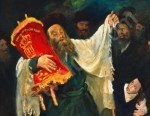
Painting by Zalman Kleinman
Repentance has four elements – charatah (regret), azivat ha’chet (abandonment of sin), kabbalah (pledging oneself) and viddui (confession).

They are all interdependent and essential. If, for instance, we abandoned sin but did not accompany this act with remorse, it might be that we did not really mean it or even really enjoyed the sin while it lasted.

That is why we also need charatah, which implies, “Not only have I stopped the sin but I truly regret ever having committed it”. On the other hand, the remorse can be there whilst the sin continues because it is hard to extricate oneself from the sinful situation.

The element of kabbalah, pledging oneself not to repeat that sin, not only confirms the remorse and abandonment of sin; it also says, “I will not do that sin again – not because the circumstances have changed and I am unlikely to be tempted again, but because it is my personal decision not to commit the sin. The decision is my free choice; I am the master of my own destiny”.

What about viddui? It adds to the other three elements the moral courage to articulate everything to God and face up to His scrutiny and judgment.