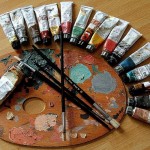
The sidra introduces us to the names of B’tzalel and Oholiav. They were the ones who designed and created the sanctuary in the wilderness.
Experts at their trade, their skills brought distinction to the tabernacle. Without them, the Israelite camp would have been much poorer. They both deserve hakkarat ha-tov, acknowledgement and appreciation.
But isn’t the Torah being more than necessarily generous when it records that God had filled B’tzalel with ru’ach Elokim, the divine spirit? One can imagine the use of such words in relation to a great thinker, teacher, prophet, preacher or poet – but here it is an artist, architect and artisan who is being described so magnanimously.
The explanation must be that there is a spirit of the Divine in all cultural creators, artists, musicians and craftsmen, even mathematicians and scientists. That is, if their principle is not art for art’s sake but art for goodness’ sake.
It is reported that Cynthia Ozick was asked what made Jewish art, music or literature Jewish, and she is said to have answered, “It has a liturgical quality”. The liturgical quality is what is meant by the Divine spirit in art.
The sidra begins with the verb t’tzavveh, “command”.
It does not say, “Speak to the Children of Israel and say to them…”, but “Command the Children of Israel”.
In the Sifrei the rabbis point out that “command” is stronger than “speak” and it implies miyyad ul’dorot, “now and for all time”.
Building the Tabernacle was not an eternal command in that sense.
In time the Tabernacle was replaced by the Temple, and though we continue to pray for the restoration of the Temple we have had nearly two thousand years in which the twin sanctuaries of the synagogue and the home have been our sacred centres.
What has never been in limbo has been the kindling of the lamp; the command was “to cause the lamp to burn continually”.
The word “lamp” means the Perpetual Light, the ner tamid; it also means bringing the light of the Divine into our lives and our world.
Part of the building program of the Tabernacle was the altar for incense.
Strangely, it is not mentioned until the end of the parashah, as if it was to be left as long as possible.
There may be a symbolism here, reflected in a Talmudic comment in Tractate Tamid that as far away as Jericho people could smell the incense that was burnt in Jerusalem in the Temple.
Smells are potent and penetrate long distances so the longer the altar of incense was left the less the impact on people’s lives.
However, Rabbi Moshe Feinstein turns what seems like a negative into a positive. A really great leader, he says, is able to send the aroma of the Torah far afield. His (we can add, “her”) influence not only permeates geographically but historically through the generations.
The altar of incense represents the original outreach projects of Judaism. So why wait so long to build this altar? Because it is the culmination of the whole sanctuary project.
Everything else has to be in place before the Tabernacle can really exert a spiritual influence.
Q. My child came home from school and said her teacher told her that Esther was Mordechai’s cousin, but I always thought that she was his niece. Which is correct?
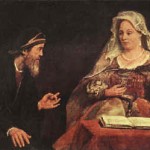
Esther & Mordechai, by Aert de Gelder, 1675
A. In spite of popular arguments to the contrary, Mordechai and Esther were not uncle and niece but cousins.
Esther 2:7 calls Esther bat dodo – “the daughter of his uncle”. The uncle’s name was Avichayil and according to the Targum Sheni, Mordechai’s and Esther’s fathers were brothers.
The uncle-niece theory probably derives from Christian and not Jewish sources: the Latin Vulgate says she was the daughter of Mordechai’s brother. However, the Catholic Encyclopedia is ambivalent, calling Mordechai her “uncle (or cousin)”.
The Jewish story tells that Mordechai, who was older than Esther, brought her up (and later married her).
Q. How can we think so highly of Queen Esther since she married out?
Painting depicting Esther & Mordechai, 1685
A. The Talmud (Sanhedrin 74b) discusses the question, offering the views of Abayye and Rava.
Both recognise that there is a problem but defend her on the basis that she did not act willingly or voluntarily but was caught up in a situation she would not have chosen.
It was, however, not a time of religious persecution, and she was not required to sacrifice her life rather than commit this transgression.
Rabbi Dr Raymond Apple zt”l passed away in January 2024. As an archive of the Rabbi’s written contributions across his many fields of interest, this site is a tribute to the man and his work. See the About section for more information on his life. Y’hi zichro baruch.
OzTorah is a weekly email service and website exploring the timeless teachings of Jewish tradition from a contemporary Australian and global perspective. The site includes insights into the parashah, an Ask the Rabbi forum, and articles on various Jewish and interfaith issues.
The content on this site may be distributed and reprinted, as long as acknowledgement is given to Rabbi Raymond Apple and the URL is included intact. https://oztorah.com.
 The sidra introduces us to the names of B’tzalel and Oholiav. They were the ones who designed and created the sanctuary in the wilderness.
 Posted by oztorah |
  Ki Tissa, Parashah Insights |
  Permalink